

One colleague prefers to work from home for a day in peace and quiet. Another thrives on campus dynamics, flexible hours or a different structure. Work-life balance at UAntwerp can’t be captured in a single formula. And that’s precisely where the challenge lies: how do we create a caring working environment that allows room for differences while remaining manageable for everyone?
No one size fits all
Within UAntwerp, there is a clear framework for telework Staff with a role that allows for telework and a contract for a minimum of 50% can work from home at least one day a week. Within these parameters, teams can operate as they see fit. At the Faculty of Arts, a specific policy framework was already developed in 2021. Faculty Director at the Faculty of Arts Virginie Coucke emphasises that this isn’t set in stone. ‘It’s best to start from a clear basic agreement that works for everyone, with room for flexibility.’
Work-life balance looks different for everyone. Take colleagues with young children, informal carers or those in roles with peak periods or on-call duties. ‘These differences aren’t a problem,’ says Kristien Lauriks, head of HR. ‘They mean that solutions aren’t the same for everyone and that flexibility always depends on context.’
Telework has a positive impact on the balance between work and private life. However, telework doesn’t automatically increase wellbeing, It only works if it’s part of a broader set of measures.’
– Kristien Lauriks
‘Being able to work from home is crucial for me. When my partner was seriously ill for a long time, telework gave me the flexibility to be there for her and still continue working at my own pace.’ Jeroen Kole, PhD student in History, Faculty of Arts
Telework increasingly popular
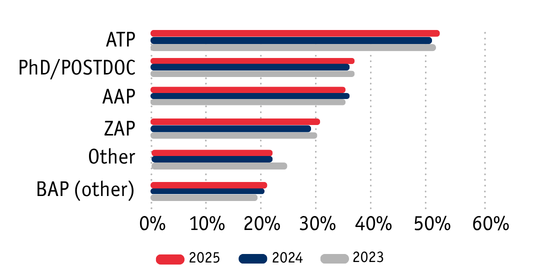
Around 35% of staff make use of telework, on average 1,6 days per week. This percentage has remained fairly stable in recent years. More than half of Administrative and Technical Staff telework, whereas amongst Senior Academic Staff this is around 30%. This variation mainly reflects differences in roles. The way a researcher works cannot be compared with an administrative role.
Monthly telework percentage per staff category
‘Working from home gives me the mental space to immerse myself in my research for longer periods. That quiet, defined environment makes deep work possible, something that can be more difficult on busy campus days. During those moments of pause, I often find renewed inspiration.’
– Eline Ceulemans, PhD student in History, Faculty of Arts
Why we need to keep connecting
Those who work from home often gain time and focus, but sometimes miss informal contact and quick consultations. That is why teams often choose moments when they see each other physically, in the form of fixed office days, in-person meetings or joint lunches. Ann Quintiens, administration officer at the Faculty of Arts says: ‘Everyone in our team has fixed days at home and on campus, which means some colleagues see each other more often than others. That’s when we discuss matters that require collaboration.’
‘Working on campus is essential for trust and collaboration, but I combine it with two to three days of working from home for efficiency.’
– Stefan Walgrave, professor of Political Science, Faculty of Social Sciences
Work-life balance is about more than working from home
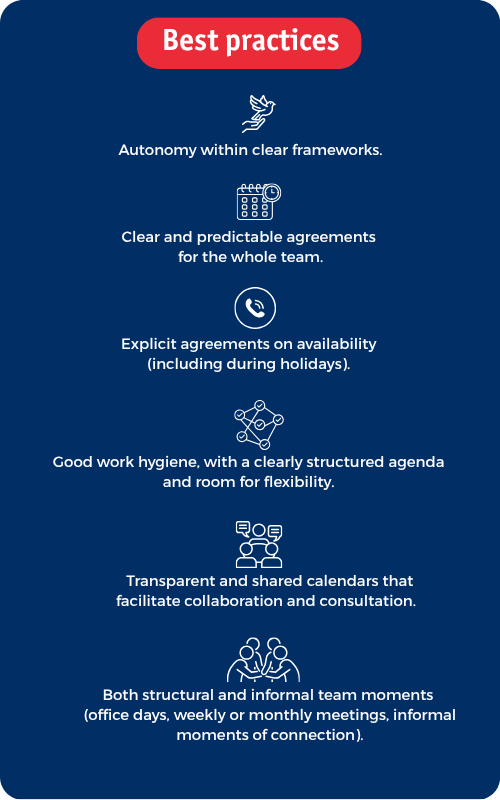
Work-life balance is also about self-care and about how work is organised: flexible hours, autonomy, team agreements on availability and room to adjust (sometimes temporarily). ‘It’s important to make explicit agreements about boundaries and availability. You don’t always have to be available,’ says Virginie Coucke.
As Sara Eloy, professor Interior Architecture says: ‘Flexibility helps, but it can also be a pitfall if you find it difficult to distance yourself from work. I have to be careful in that respect.’ Several staff members say that making a conscious effort to take breaks and allow time to recharge helps them to maintain their balance even during busy periods, and to start the working day with more energy.

‘Flexible hours help me to align work and family life. As an event manager, there are periods when I work many hours, but I can recover that overtime during quieter periods.’
– Lisa De Haardt
What makes it work?
Well-functioning teams make clear agreements about when they’re available, when they see each other and how they handle absences. This prevents a sense of arbitrariness.
For Pieter Caris, director of the Faculty of Design Sciences, it works both ways. ‘Work-life balance is about the balance between what an individual needs and what a department needs to function well. Autonomy and trust are crucial in this.’ He emphasises that differences are inevitable: ‘Not every role allows the same flexibility. If you explain that properly, people understand.’
Staying connected in a hybrid reality
Greater flexibility means that connection often becomes less self-evident. ‘Colleagues see each other less spontaneously, while it’s precisely those informal moments that create connection within a team,’ says Pieter Caris. ‘On days when we’re in the office together, everything runs more smoothly. It’s easier to coordinate things and pick up signals.’ Many teams therefore invest in fixed office days or shared moments, not as an obligation but as a way of boosting collaboration and knowledge sharing.
‘We can’t do without digital communication. As many of my colleagues are spread out teaching, attending conferences or doing fieldwork, it helps to share information quickly and still stay connected.’ Suzie Thomas, professor Heritage, Faculty of Design Sciences

“A monthly staff meeting and a fortnightly online team meeting help us stay connected. There is also an opportunity to voice any concerns.”
– Hilde De Vleeschhauwer, Programme Coordinator, Faculty of Design Sciences
Caring leadership. Everyone is different.
‘Managers make the difference,’ says Virginie Coucke. ‘Give space where possible, but also be clear about why something is or isn’t possible, in full transparency, both towards the individual and the entire team.’ Kristien adds that this comes down to situational leadership: enabling staff to perform at their best within the team. ‘But you do have to explain why you make certain choices. And if something feels off, you need to start the conversation,’ says Pieter Caris.
Virginie Coucke also points out that managers must pay attention to general wellbeing, beyond telework or flexible hours: a physical workspace that suits someone’s needs, attention to sensitivity to stimuli, room for recovery and a culture in which small signals are noticed all make a difference.
‘My manager gives me a lot of trust as a researcher. The freedom to organise my work means I can take responsibility and follow my own rhythm, while knowing that support is there when I need it.’ Eline Ceulemans
Managers who want to learn more about this can follow training courses, including on peer assessment, feedback, connection through communication and stress detection. You can find the full range in PeopleSoft.
One university, many ways to stay balanced
Work-life balance isn’t a fixed destination, but evolves with the way we work and collaborate. By keeping the conversation open, making clear agreements and allowing room for differences and nuance, we’re building a working environment together in which people and teams can function sustainably, connected to one another and with attention to what they need.
Want to know more?
In the telework brochure and on the We Care subsite on Pintra, you’ll find guidelines, contacts and tips on wellbeing for managers and staff.