

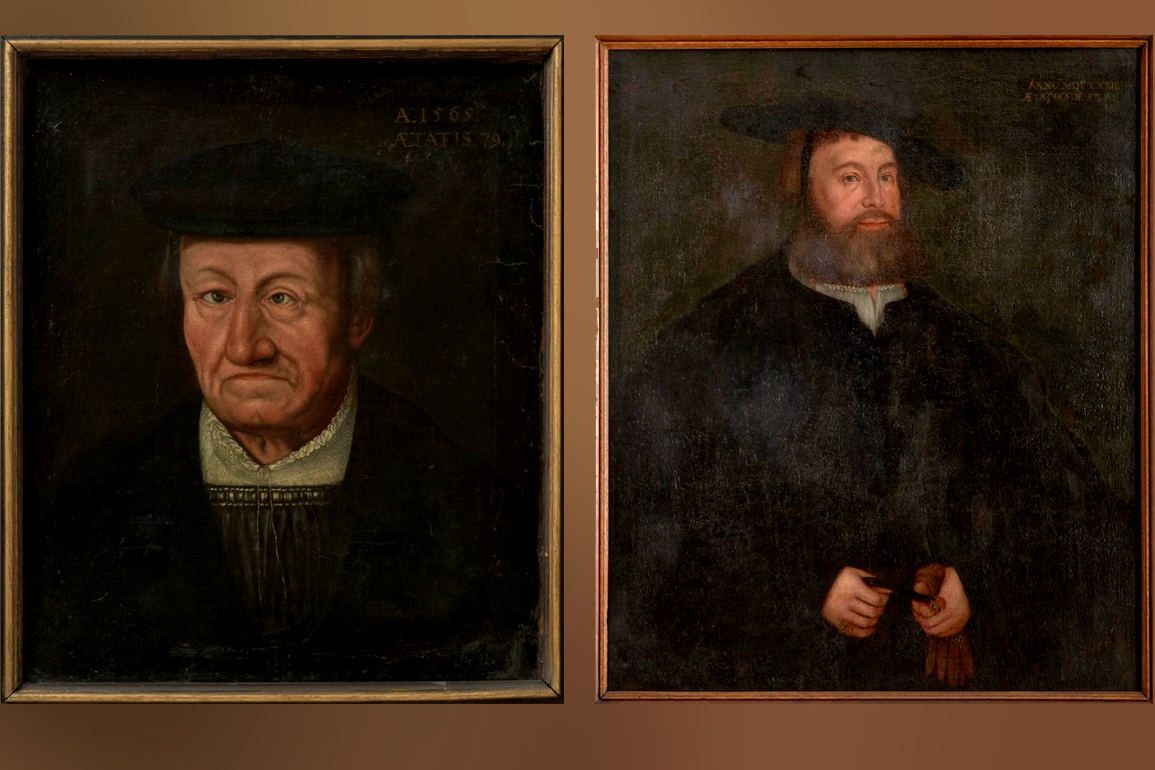
Portraits: Linhart II Tucher (1487-1568), 1565 / Lorenz II Tucher (1490-1554), 1543, Kunstsammlung der Familie Tucher von Simmelsdorf, Bestände des Museums Tucherschloss und Hirsvogelsaal
Before standardised planning tools and complex economic forecasting techniques became available, merchants prepared plans and predictions as well. About 45 % of an average letter in the Tucher trading company from Nuremberg pertained to the future – and these letters tell us a lot about how merchants thought about the future in the sixteenth century. The Tucher family traded mostly with saffron from Spain and France, but also everything else that seemed profitable at the central hubs of European trade at the time: Lyon and Antwerp. In a world of constant political and military conflicts, apocalyptic expectations and volatile prices, preparing for the future was as complex as it was necessary. (Text: Max-Quentin Bischoff)
The future in letters
The Tucher company was formed by two managing partners – the cousins Linhart (1487-1568) and Lorenz Tucher (1490-1554) – who pulled the strings from Nuremberg. They organised their trade through letters they exchanged with agents who were living and travelling in France, Spain and the Low Countries. These letters included a wealth of news from the recent past, such as price developments, political and military events, and reports of what the company had achieved.
Moreover, letters turned to the future: they contained hopes, fears and predictions as well as instructions and promises, plans and goals. At first glance, the majority of such future statements seem quite simple. The agents – mostly family members and contracted servants – regularly promised their eternal loyalty and coordinated the day-to-day business operations. But a closer look reveals more complex and fascinating details. If we read the scattered letters by different writers as one ongoing group conversation, we can detect how the Tuchers pursued more long-term plans and how they formed market predictions.
Making plans
Short-term business coordination consisted largely of three fields: communication and information management, work coordination, and travel preparations. In addition to simple announcements, instructions and promises, the letters include detailed scenarios with planned reactions for particular circumstances.
While the company operated through fixed branches at major marketplaces, servants were almost constantly on the move to take care of investments or specific tasks. At the same time, servants were individuals with different levels of experience, skills, strengths and weaknesses. This had to be taken into account when planning the distribution of work for the coming weeks and months, but also on a more fundamental level. Good servants were difficult to find and often had strong personal ambitions themselves. Thus, the Tuchers had to consider how many servants they would need, how much they were willing to pay, and what kind of position they were willing to grant them.
Like many family companies today, one of the greatest challenges was to hand over the business to the next generation. This required a carefully planned education, taking individual characteristics and personal development over time into account. Not only hired servants were excluded from succession in ownership, also all sons who did not meet their fathers’ expectations.
Economic forecasting
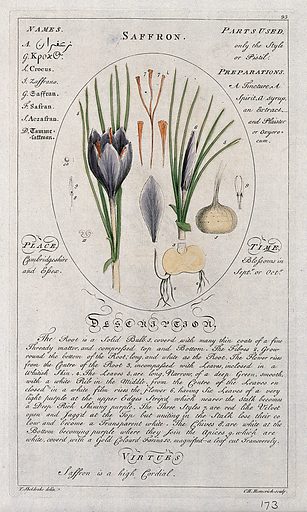
The Tuchers bought saffron directly from the farmers in Spain and France to sell it to smaller merchants in Nuremberg. Since the saffron prices were highly volatile, merchants had to buy and sell at the right time – and just like today, identifying the right time required predictions of future price developments. To do so, the Tuchers analysed several factors (such as weather, current prices, and rumours of war) and formulated specific target prices and volumes. Since uncertainty remained high, one of their servants proposed a prognostic system based on astrology and market mechanisms that (allegedly) promised guaranteed profits. While his idea raised interest and was even tested, it was also highly controversial within the company and quickly abandoned.
Contact
Max-Quentin Bischoff | max-quentin.bischoff@uantwerpen.be
Learn more about the research project: Back2thefuture
Saffron image: Saffron crocus (Crocus sativus L.): flowering stem with separate floral segments and bulb and a description of the plant and its uses. Coloured line engraving by C.H.Hemerich, c.1759, after T.Sheldrake.