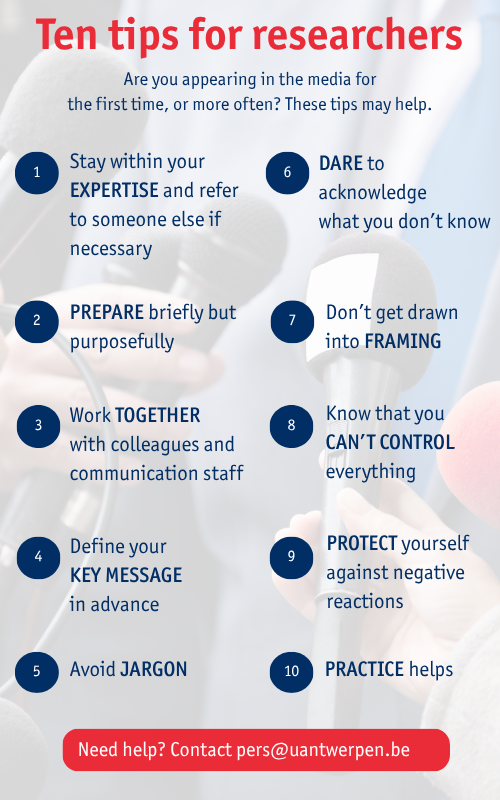

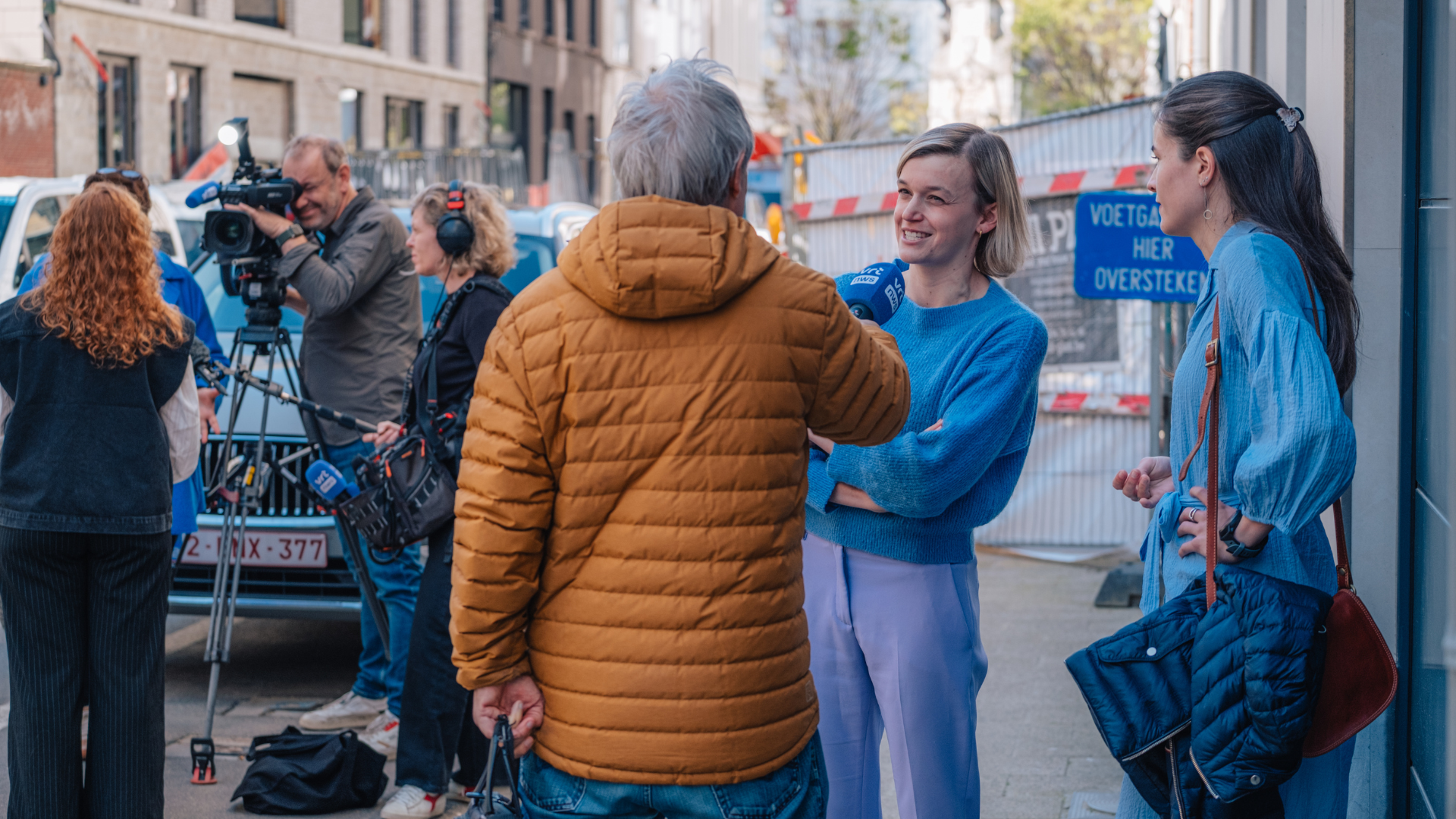
Researchers are increasingly asked to share their expertise in the media, sometimes in response to their own research, sometimes to provide context for current events. That visibility creates opportunities. It shows what UAntwerp stands for: sharing knowledge, bringing nuance and contributing to debates in society. In most cases, media interactions run smoothly: researchers are given the space to share their expertise and work with journalists who approach things carefully and accurately. But media attention also brings responsibility. And pressure.
What does a media appearance involve? How do researchers stay true to their scientific integrity? How do they deal with framing, pressure and reactions? Let’s take a look behind the scenes.
Researchers don’t speak in a neutral space
Today, researchers who appear in the media do so within a complex and digitalised media landscape. According to Professor Catherine Van de Heyning, specialised in European fundamental rights, that’s a crucial starting point. A statement rarely remains limited to the original interview or medium. ‘What you say is immediately picked up and shared, often with commentary, sometimes completely outside the context in which it was said.’
Television clips take on a life of their own on social media. A nuanced conversation is often reduced to fragments in which the context disappears and a different interpretation emerges. At the same time, researchers emphasise that this isn’t the norm for every interview: many conversations do remain within their context and still leave room for nuance, especially when there’s enough preparation time and coordination.
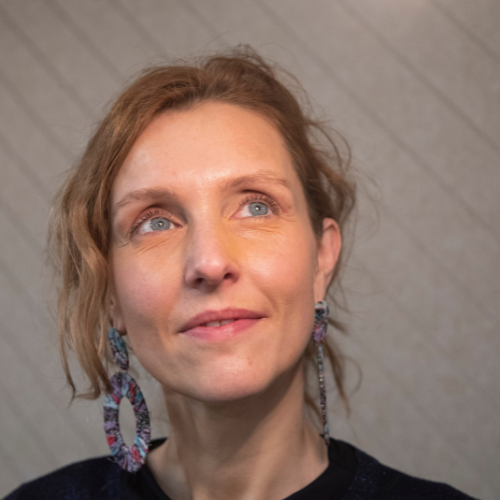
‘What we present as scientific facts is sometimes seen as a personal opinion or conviction. Researchers are sometimes boxed into a particular camp.’
– Catherine Van de Heyning
It’s sometimes difficult to simply ‘present the facts’. Because how those facts are received isn’t in your hands. According to Catherine, there’s also a second layer of framing, especially after the interview. ‘That second framing often happens online and means that researchers are sometimes boxed into a particular camp. Objective knowledge is sometimes interpreted as a personal conviction or opinion. Or worse: as a position within a broader polarised debate.’
Preparation under time pressure
Media requests often arise from current events. That means little time and extra pressure. Still, speed should never come at the expense of accuracy. This is why many researchers prepare carefully:
- they check the context
- they look up recent figures
- they formulate their key messages in advance
Professor Laure Jacquemin, audiologist who specialises in research into hearing damage, writes down those key messages. ‘There’s always a certain tension. Journalists often want a black-and-white message, while we want to bring nuance. It helps if I can fall back on my key messages during the conversation.’ She remembers one interview in which the discussion drifted towards a side issue. ‘The journalist kept asking about barking dogs, even though that wasn’t my main message. Fortunately, that fragment didn’t make it into the news bulletin.’
‘Journalists often want a black-and-white message, while we want to bring nuance. It helps to be able to fall back on my key messages.’
– Laure Jacquemin
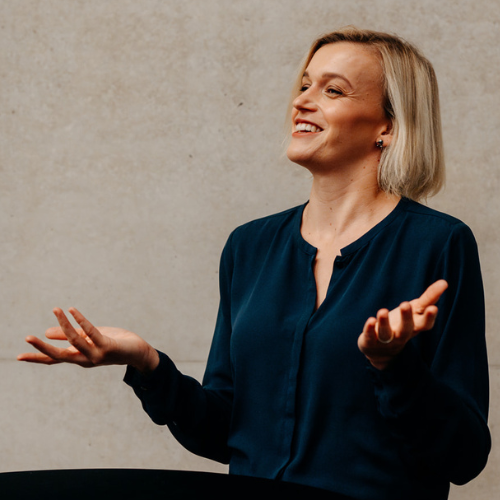
Preliminary conversations with journalists are also important. They help researchers understand the angle and sharpen the message. According to Professor Peter Van Aelst, specialised in political communication, that’s part of the job: ‘You learn what a medium needs and adapt your answers accordingly without letting go of the content.’ Catherine notes that journalists sometimes keep pushing, even when you indicate that the question falls outside your expertise. ‘You say: this isn’t my field. And still they ask you to say something about it.’ That makes it even more important to guard your boundaries, especially under time pressure.
And sometimes things move incredibly fast. Professor Erika Vlieghe, infectiologist at Antwerp University Hospital, explains how news requests start pouring in within hours when there’s a possible virus outbreak. ‘What starts as an ordinary working day can suddenly feel like going back to Covid. You have to switch quickly, look up information and provide context.’
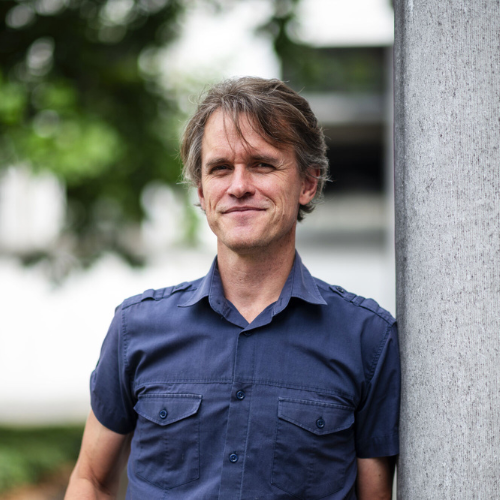
‘By first having a preliminary conversation with a journalist, you learn what a medium needs and adapt your answers accordingly without letting go of the content.’
– Peter Van Aelst
Nuance versus simplicity
Journalists look for clarity: a clear message, preferably in a single sentence. But science works differently: with nuance and within a specific context. In practice, many researchers succeed in making that translation without losing their message. But it does require preparation.
‘For the news bulletin, I know I get two times twelve seconds,’ says Peter. ‘Then you shouldn’t explain your entire research project, but focus on the essence.’ Media requests also often stem from current events: ‘They don’t always call me about my research, but for example about a conflict within a political party. Then you have to quickly assess whether you can say something meaningful about it.’ Sometimes that comes close to the limits of their expertise. Peter has received questions about statements by Melania Trump or even about Bart De Wever’s cat. ‘Those are more marginal topics where I wonder whether I’m really adding anything useful.’
A media appearance always requires careful consideration. How far can you simplify without distorting your message? According to Erika, however, it’s possible to make complex information understandable if you consciously choose clear language and concrete examples.
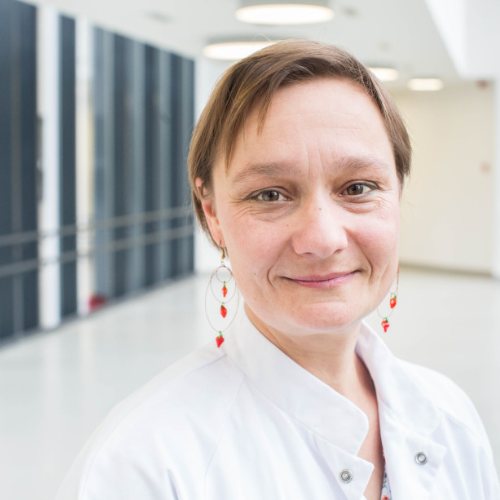
‘A media appearance requires preparation. You want to communicate your message as clearly as possible. If you consciously choose clear language and concrete examples, you can even make complex information understandable.’
– Erika Vlieghe
Integrity under pressure
Besides clarity, there’s also the question of how to remain scientifically accurate when the pressure increases to communicate more quickly and with greater certainty. Here, researchers follow a number of basic principles:
- stay within your expertise
- clearly acknowledge what you don’t know
- avoid absolute statements
But according to Catherine, communicating correctly isn’t always enough. ‘In highly polarised topics, facts alone don’t always achieve your goal. It also requires insight into how information is received and how convictions influence perception.’ Erika emphasises that it’s important to recognise when a question is no longer about facts, but about policy or opinion. When a journalist asks you what you think should happen now, the conversation shifts. ‘Guarding that boundary isn’t easy, but it’s essential for your credibility.’
From ego to consideration: should I accept this request?
Many researchers quickly say yes to media requests at the start of their careers. ‘It flatters your ego,’ says Peter. ‘But over the years, you realise that not every request is a good idea and you become more selective. Time also plays a role: if I don’t have enough time to prepare, I prefer to say no.’
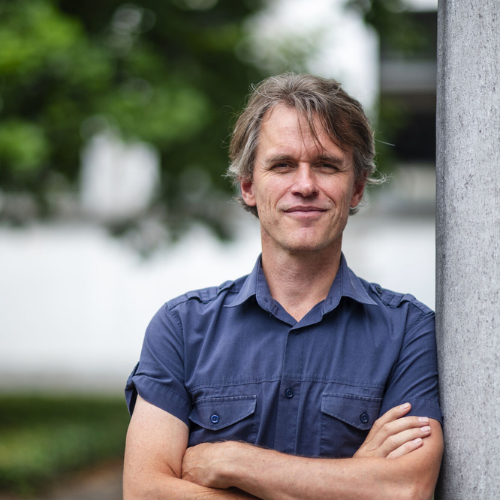
‘Over the years, you realise that not every request is a good idea and you become more selective. If I don’t have enough time to prepare, I definitely prefer to say no.’
– Peter Van Aelst
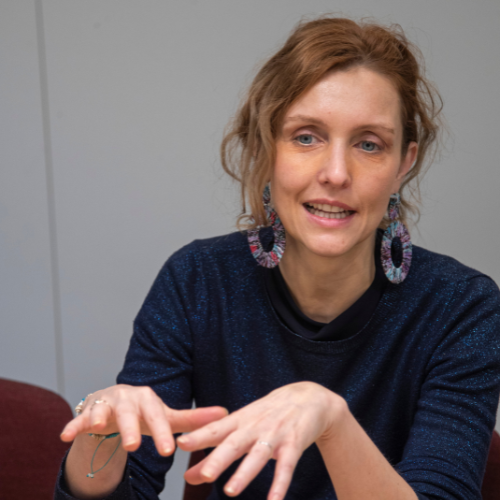
Catherine asks herself the same questions every time: ‘Does this fall within my area of expertise? Am I really contributing something? Or is this mainly about visibility?’ She also consciously refers journalists to colleagues, paying attention to diversity. ‘The media still too often show the same profile: the cliché image of the wise, grey, male professor. That gives the wrong impression of who professors are today.’
‘The media still too often portray the same stereotype: the cliché of the ‘wise’, ‘grey-haired’, male professor. This gives the wrong impression of who professors are today.’
– Catherine Van de Heyning
What sticks (and what doesn’t)
Researchers often have little control over what sticks in the media and what they are asked for. ‘At one point, there was a lot of attention for noise-cancelling headphones and I commented on them once. It wasn’t my main area of research, but I still get questions about it today,’ says Laure. ‘Other socially relevant topics, such as hearing problems in children, receive less attention.’ What’s recognisable tends to stick, including for journalists themselves.
Framing has an impact
Researchers give interviews, but they have no control over the title, quotes or context. A nuanced answer can quickly be reduced to a label: for or against, left or right. ‘You’re very quickly boxed into a particular camp. While that’s exactly what science tries to avoid,’ says Catherine.
Erika recognises that. ‘You explain something in a nuanced and careful way. And the next day you read a headline that sounds more firm than you intended.’ During the Covid pandemic, this became very obvious. Because she was ‘at the decision-making table’, people later suggested that she had approved political decisions. ‘That moment made it clear how quickly scientific and political communication become intertwined.’
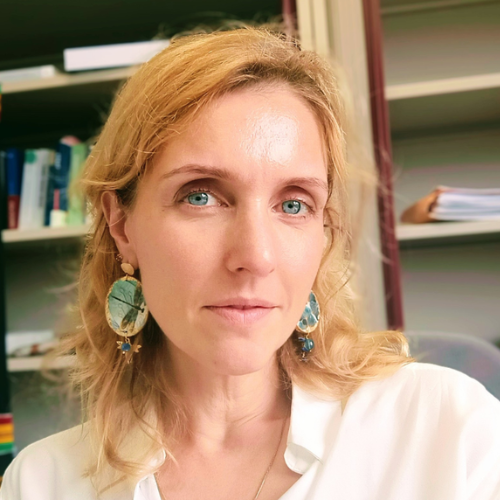
‘You don’t always have no control over the title, quotes or context. You’re very quickly boxed into a particular camp. While that’s exactly what science tries to avoid.’
– Catherine Van de Heyning
Peter describes a similar frustration: the unpleasant feeling that the nuance disappears and your role is reduced to ‘a professor saying something’. Sometimes there are direct consequences as well. Laure gives the example of tinnitus. ‘It’s often presented very negatively. While in practice many people learn to cope with it quite well.’ After media coverage, she notices that patients become more worried. ‘The next day our phone line is red hot.’
‘After media coverage of tinnitus, we see that patients become more worried. The next day our phone line is red hot.’
– Laure Jacquemin
Dealing with (hate) reactions
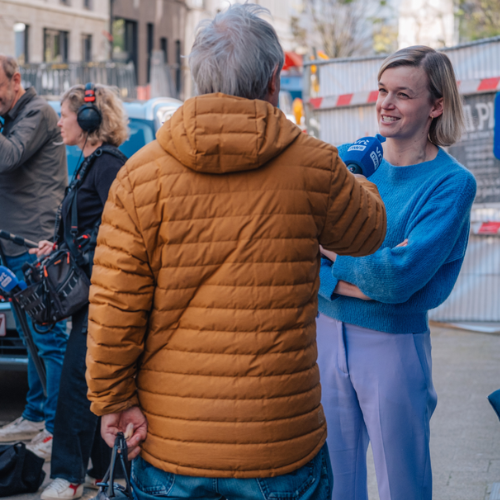
Behind every interview is a person. Visibility not only brings impact, but also emotional pressure: the feeling that you ‘have to get it right’ and the reactions afterwards. During the Covid pandemic, Erika received not only many positive reactions, but also personal and sometimes very harsh messages. ‘That affected me, especially in the beginning.’
Peter recently received a negative reaction after a radio interview about Donald Trump: ‘It was pure abuse. The listener saw me as a Trump supporter, while I had only provided context on why so many people continue to support Trump. That was when I thought: I don’t want to get into this too much.’
‘During the Covid pandemic, I received many positive reactions, but also personal and sometimes very harsh messages. That affected me.’
– Erika Vlieghe
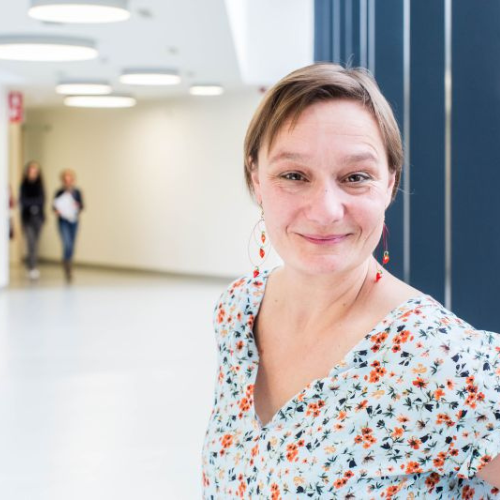
Catherine doesn’t read reactions. ‘Not out of indifference, but out of self-protection.’ She argues that the university should provide better support for researchers in this respect, for example by filtering or helping to follow up on negative reactions.
The role of colleagues and support
Researchers don’t stand alone. Colleagues are an important sounding board. The university’s press office also plays a key role in preparing interviews, assessing risks and offering guidance. That support is essential, especially in complex or sensitive situations. It makes a major difference in how messages are communicated and received.
Science communication isn’t a side issue
The researchers all agree that media work remains essential. Despite the challenges, they generally have a positive outlook on their experiences with the media. ‘If nobody reads your research, it has little impact,’ says Laure. Catherine stresses our broader role: ‘We have a responsibility to society. We need to continue contributing to the debate. If researchers withdraw because of pressure or negative reactions, their research topics will also disappear from the media and the debate.’
Science communication is therefore not merely an individual choice, but a collective responsibility. Our media appearances help shape how UAntwerp is seen: as a reliable and innovative knowledge partner that contributes to society.
Do you need support?
The press office of the University of Antwerp is happy to help with:
- media requests
- interview preparation
- translating research for a broader audience
- writing press releases
Are you appearing in the media?