

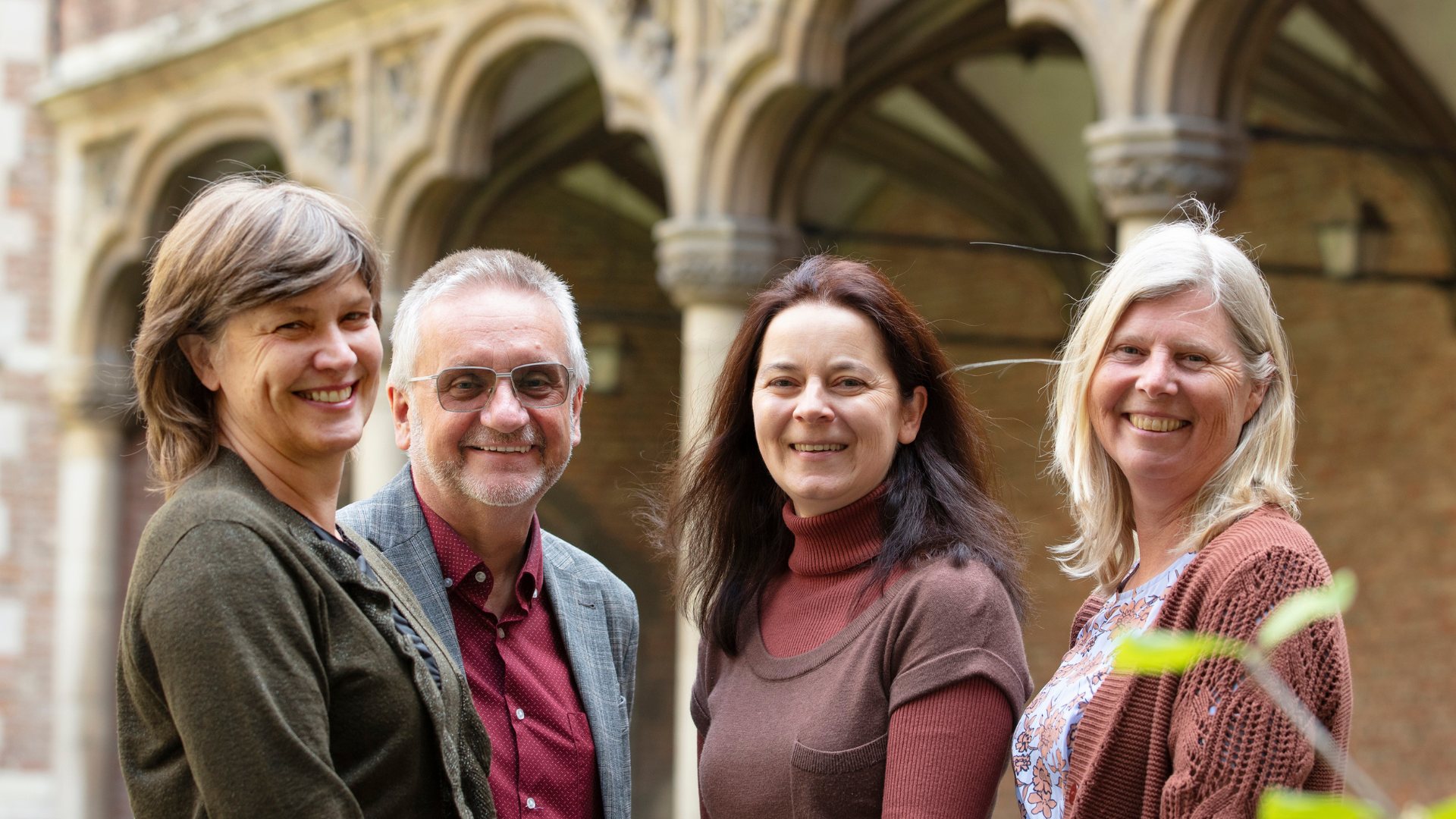
The Antwerp School of Education (ASoE) celebrated its anniversary at the beginning of May with a festive study afternoon. For the past 10 years, the academic expertise centre has been building bridges between research, education and practice. We spoke to four key figures about the evolution of the teaching profession and the power of collaboration. ‘When major changes in direction are made, we’re often involved in shaping them.’
Each year, around 300 students at UAntwerp enrol in a Master in Teaching programme, dreaming of one day standing in front of a classroom. Today’s graduate teachers face very different challenges from those of, say, 20 years ago. The student population, for example, has changed significantly. ‘There’s much more multilingualism, meaning that every teacher today must pay attention to language development,’ says Professor Elke Struyf, chair of the Education Committee of the academic teacher training programme. ‘We’re also moving towards more inclusive education, where students with disabilities increasingly find their way into mainstream schools. There has also been a clear shift towards evidence-based practice. And, of course, we can’t ignore technological innovations such as AI, which raise the question of how we can use them constructively to help our students become better teachers.’
Luc Pierrart, director of the In-service Teacher Training Centre (CNO), also notes that data literacy is becoming increasingly important: ‘For example, it’s no longer enough to simply mark tests. Teachers need to work with the data as a basis for remediation, adapting their teaching methods or adjusting their assessment practices.’ Because of all these challenges, collaboration between teachers and other education professionals has also become increasingly essential.
Expectations in higher education are rising too, says Ann Stes, education coordinator at the Centre of Expertise for Higher Education (ECHO). ‘It’s no longer enough to be an expert in your field. Today, lecturers must also focus on inclusion, sustainability and interdisciplinarity. This is reflected in the innovations we’re introducing in the professional development and support we offer.’
Cross-fertilisation
Within this changing landscape, ASoE is strongly committed to high-quality training. Professor Chris Van Ginneken, chair of ASoE: ‘We focus both on initial teacher training through the Master in Teaching programmes and on the further professional development of those already working in education. To this end, CNO offers programmes for teachers in primary, secondary and adult education, while ECHO focuses on our own lecturers and education support staff. Our strength lies in bringing together these three entities — the teacher training programme, CNO and ECHO. This creates cross-fertilisation in which research and practice reinforce one another.’
Scientific research forms the cornerstone of ASoE, with Didactica bringing together the research conducted by Senior Academic Staff (ZAP) involved in the Master in Teaching programmes. New insights are sometimes translated directly into the curriculum of these programmes. For example, the research project Focus op Taal led to greater attention being paid to low literacy in Dutch subject didactics.
‘ECHO draws on research insights, for example in relation to inclusive education for disadvantaged groups. Lecturers can further develop their knowledge through lunch sessions and other initiatives.’
– Ann Stes
In addition, CNO’s programmes help ensure that research insights are smoothly transferred to classroom practice. Luc Pierrart: ‘This knowledge is often freely available through guides and websites, but it remains important to bring teachers and school leadership teams on board. A good example is our theme day on classroom management that took place on 25 September 2025. We offered workshops, Elke Struyf delivered the keynote address and all participants received a copy of the inspiration guide on effective classroom management and a safe learning climate that supports learning.’
‘ECHO, too, draws on research insights, for example in relation to inclusive education for disadvantaged groups. Lecturers can further develop their knowledge through lunch sessions and other initiatives,’ adds Ann Stes.
From research to educational tools
Research also results in practical tools for lecturers and teachers. Research into care at school, for instance, led to a handbook for education professionals, accompanied by a toolbox with game materials for student guidance. ECHO recently developed a guide to assessment formats, offering practical guidance on inclusive evaluation.
One of ASoE’s major strengths is the collaboration between its different entities. Luc Pierrart: ‘It’s a great advantage that CNO is embedded within the university. We’re close to the scientific source and to the researchers. This creates valuable interaction, including through our working groups. Subject didacticians, teaching assistants and education professionals work together in these groups, enabling researchers to gain insight into practice while teachers, school leaders and support staff stay up to date with the latest scientific insights.’
‘It’s a great advantage that CNO is embedded within the university. We’re close to the scientific source and to the researchers. This creates valuable interaction, including through our working groups.’
– Luc Pierrart
Guiding role in policy
Policymakers also regularly turn to ASoE for expertise. Professor Jordi Casteleyn, associate professor at ASoE, chaired the committee responsible for the new minimum attainment targets for Dutch in primary education. The Taal+ project, which developed a two-year professional development programme on language pathways in primary education, was also created at the government’s request. Through this project, CNO helped dozens of schools move forward. ‘It’s rewarding to help shape educational innovation. As a university, that’s also part of our role,’ says Professor Struyf.
‘It’s rewarding to help shape educational innovation. As a university, that’s also part of our role.’
– Professor Struyf
The TALENT project, which focuses on cognitively gifted students, is another strong example of this impact. Together with KU Leuven and Ghent University, ASoE contributed to a knowledge platform where schools can find the necessary materials. Ann Stes: ‘At ECHO, we also pay attention to this topic. Over the past year, we organised two sessions on giftedness in higher education, with the TALENT project serving as a source of inspiration. The challenge is then to translate these insights to the higher education context.’
A strong start
All four are convinced of the unique added value of an academic teacher training programme. Elke Struyf: ‘Our graduates are content experts in their domain, with an additional layer of subject didactics. They’re also used to working with data and scientific literature. This research-oriented attitude benefits both classroom practice and school policy. We’re currently working on guidelines for a positive group climate, for example. In so doing, we encourage schools to base their approach on data. According to the literature, what are effective ways to tackle bullying? How do you evaluate the impact of those measures?’ Professor Van Ginneken adds: ‘The strength of the Master in Teaching programmes is that they’re grounded in recent research. As a result, a master programme today isn’t the same as it was five years ago.’
‘The strength of educational master’s programmes lies in the fact that they are grounded in recent research. As a result, a master’s programme today is not the same as it was five years ago.‘
– Chris Van Ginneken
Lifelong learning
Teachers and lecturers never stop learning, even after completing their education. Luc Pierrart: ‘A Master in Teaching programme comprises 60 credits. That’s not enough to study all developmental and learning disorders in depth, for example. CNO responds to the needs that remain after completing the teacher training programme. It’s the only institution in Flanders to offer an academic postgraduate programme for school leaders in secondary education.’
ECHO also encourages everyone with a teaching role to continue developing professionally. Ann Stes: ‘It doesn’t stop once you’ve obtained the University Teaching Qualification (UTQ). Further professional development remains valuable. If you want to deepen your knowledge of peer assessment, for example, additional sessions are needed.’
In other words, teachers and lecturers must continue learning throughout their careers. Elke Struyf: ‘Since we can’t cover everything in the initial programme, we have to make smart choices. Even then, a certain frustration remains. We fill the gaps with a varied professional development offer: from short training sessions to postgraduate programmes, but also inspiration guides, books, posters, toolkits, webinars, knowledge platforms, etc. Through this broad range, we aim to reach as many target groups as possible.’
Some figures
Just over 300 students are enrolled in a Master in Teaching programme. Most opt for the shortened programme after obtaining their (domain-specific) master degree.
In the 2024-2025 academic year, 18,415 education staff members from across Flanders and from all education networks participated in a CNO professional development programme.
In the 2024-2025 academic year, 335 UAntwerp staff members attended at least one professional development session organised by ECHO.