

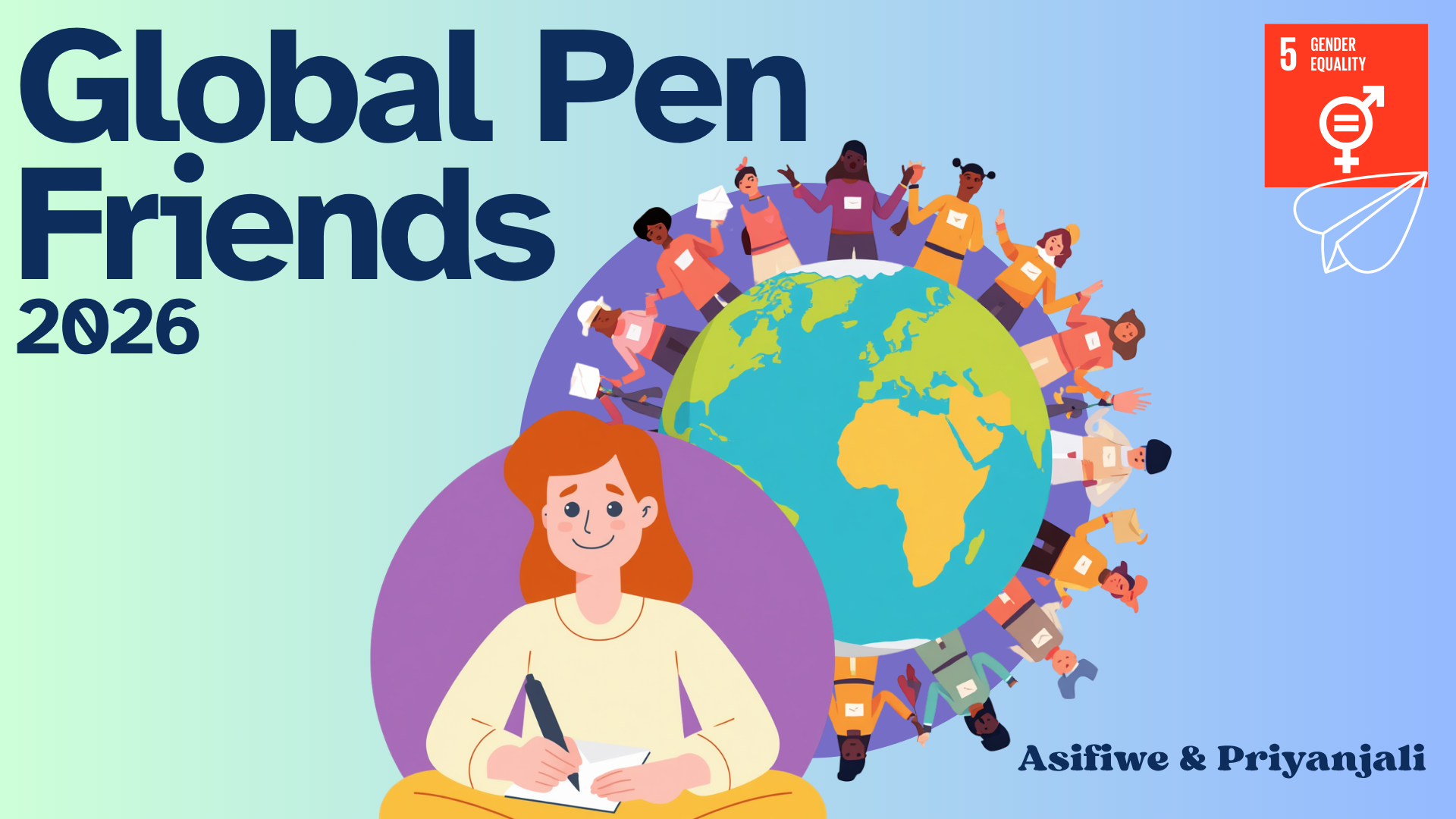
This letter exchange between two students from India and the Democratic Republic of Congo explores gender equality and girls’ education through personal journeys, leadership experiences, and shared reflections. It highlights persistent barriers such as poverty, tradition, and conflict, while emphasizing resilience, mindset change, and the transformative power of education in empowering young women and shaping more equitable societies.
LETTER 1
PRIYANJALI KUMARI
Dear Espérance
I hope you are doing well. I am Priyanjali a law student from India. It feels wonderful to write to you and share my thoughts on something very meaningful, Sustainable Development Goal 5, which focuses on Gender Equality. This goal is important not just globally, but also very personally to me because of where I come from and what I have experienced growing up.
I am from Bihar, a state in India where education is now becoming a primary focus, especially for girls. Earlier, many girls were not given equal opportunities to study, but today things are slowly changing. There is a strong wave of awareness across India that emphasizes the importance of educating girls. Families are beginning to understand that education is not just for boys, but equally important for girls to build a better future.
I feel very lucky because I studied in an all-girls school. It was a place where we were taught discipline, respect, and confidence from a young age. Our teachers encouraged us to express our thoughts freely and to believe in ourselves. Being surrounded by other girls who were equally motivated created a very supportive environment. It helped me grow not just academically, but also as an independent and confident individual.
Through my education, I have understood how important gender equality truly is. Gender equality means that boys and girls, men and women, should have the same rights, opportunities, and respect in society. It is not just about fairness, but also about progress. A society can only truly develop when everyone is given equal chances to contribute and succeed.
Girls’ education is not only about going to school, but also about creating equal opportunities in every aspect of life. When a girl is educated, she gains knowledge, skills, and confidence that help her become independent. She is more likely to participate in decision-making within her family and society. Education also improves health awareness, financial independence, and overall quality of life. In many cases, educated women ensure that their own children, especially daughters, also receive education, which helps break the cycle of inequality. This shows that investing in girls’ education is one of the most powerful ways to create long-term social and economic development.
Girls’ education plays a key role in achieving this equality. When girls are educated, they become more aware of their rights, they can make their own decisions, and they are less likely to face issues like early marriage or dependence on others. Educated women can work, support their families, and even inspire future generations. In this way, education creates a cycle of empowerment.
However, despite the progress, challenges still exist. In some areas, girls still face difficulties in continuing their education due to social norms, stigma, or a lack of resources. That is why goals like SDG 5 are so important; they remind us that we still have work to do and encourage us to keep moving forward.
Even today, many girls continue to face serious barriers that prevent them from accessing education and achieving equality. One of the biggest challenges is poverty, where families may prioritize a boy’s education over a girl’s due to limited resources. In some communities, traditional beliefs and social norms still suggest that a girl’s primary role is within the household, which discourages families from investing in her education. Early marriage is another major issue, as it often forces girls to drop out of school at a young age and limits their future opportunities. Safety concerns, such as long distances to schools or lack of proper facilities, also make it difficult for girls to continue their studies. In addition, the absence of proper sanitation facilities in schools can discourage adolescent girls from attending regularly. These barriers are not just individual problems; they reflect deeper inequalities in society. Overcoming them requires collective efforts, including better government policies, awareness campaigns, community support, and equal encouragement from families. When these barriers are addressed, girls are not only able to complete their education but also participate fully in society, contributing to economic growth and social progress. Achieving true gender equality means ensuring that no girl is held back because of her circumstances, and that every girl is given the chance to learn, grow, and succeed.
I would love to know more about your country and your experiences regarding gender equality and girls’ education. It would be interesting to learn how things are different or similar in your place. Sharing these ideas helps us understand the world better and also inspires us to bring positive change.
Take care and I look forward to your reply.
Warm regards,
Priyanjali
LETTER 2
ASIFIWE CIRIMWANI ESPERANCE
Dear Priyanjali,
I hope you are doing well. I truly enjoyed reading your letter. Your reflections on gender equality and girls’ education are both insightful and deeply inspiring. I could feel your sincerity and commitment through every word.
Thank you for sharing your experience with me. In many ways, your story resonates with mine.
I come from the Democratic Republic of Congo, and like you, I had the privilege of studying in a girls-only school, Lycée Wima. It was not just a place of learning, but a space where young girls were shaped into confident and responsible women. During my time there, I had the honor of serving as head girl, representing all the students. This experience taught me a great deal above all, the power of a young girl who is given the opportunity to rise. From an early age, I made the choice to push myself into positions of responsibility, not solely out of personal ambition, but because I deeply believe that when a young woman sees another young woman lead, she begins to believe that it is possible for her too. To me, inspiring others goes beyond words, it is about action, about showing up, and about taking up space where young women are not always expected. Unlike many girls, I was fortunate to grow up in a family where equality was not a struggle, but a reality. Coming from a large family of seven girls and four boys, I was raised in an environment where opportunities and expectations were the same for everyone. This gave me a strong foundation and allowed me to grow up without ever questioning my worth. However, beyond my personal experience, the reality for many girls around me is very different. I have seen friends whose dreams were cut short, not because they lacked intelligence or ambition, but because of the circumstances imposed on them. In some communities, when a girl struggles in school, people quickly say, “kuko mwenye iko namu someya,” meaning “there is already someone studying for her,” as if education is not meant for her, as if her future can simply be replaced by marriage. For many, marriage becomes not a choice, but a solution imposed on them, almost an escape from hardship. In the eastern part of my country, the situation is even more complex due to ongoing insecurity and conflict. Poverty, social expectations, and instability continue to limit girls’ access to education. Beyond poverty and insecurity, another major challenge lies in certain deeply rooted traditional practices and ancestral norms. In some cultures, the role of women is still defined by old expectations: obedience, early marriage, and prioritizing domestic roles. These practices, often justified in the name of tradition, continue to hinder the empowerment of young girls. They are not always imposed violently, but they are powerful because they are normalized. Despite all these challenges, what strikes me most about us Congolese girls, is our resilience. We carry dreams in environments that sometimes try to silence us. We continue to hope, to fight, and to move forward, even when the path is uncertain. Like you, I strongly believe that education is one of the most powerful tools for social transformation. When a girl is educated, she does not only transform her own life, she changes the trajectory of her entire community. She becomes a voice, a force, and a possibility for others. Reading your letter reminded me that even though we come from different parts of the world, our realities are deeply connected. The challenges may take different forms, but the goal remains the same: to build a world where no girl is limited by her gender. Thank you again for your message and for sharing your experience with such honesty. Exchanges like this give me hope and reinforce my belief that our generation is ready to take on this responsibility and create real change. I would be delighted to continue this conversation and to learn more about your journey and your aspirations in the field of law.
Take care, and I look forward to hearing from you again.
Yours sincerely,
Espérance
LETTER 3
PRIYANJALI KUMARI
Dear Espérance,
I hope you are doing well. Thank you so much for your thoughtful and heartfelt letter. I truly enjoyed reading about your experiences, your school life at Lycée Wima, and your perspective on gender equality and education. Your words reflected both strength and hope, and they made me reflect even more deeply on how connected our experiences are despite coming from different countries and cultures.
While reading your letter, I realized how similar many of the challenges faced by girls are across the world. The circumstances may be different, but the underlying issue often remains the same: girls still have to prove that their dreams, education, and ambitions matter equally. In many societies, girls are still expected to limit themselves according to traditional roles, while boys are encouraged to explore opportunities more freely. This imbalance affects not only education, but also confidence, independence, and the ability to make choices about one’s own future.
I strongly believe that achieving gender equality is not only about changing laws or policies, but also about changing mindsets. Real change begins when families teach both boys and girls to respect each other equally. When schools encourage girls to lead without hesitation, and when society stops treating women’s success as something unusual. Equality should not mean that girls have to constantly fight for space; it should mean that opportunities naturally belong to everyone.
Another important aspect of girls’ education is how it contributes to the development of entire communities. When girls are educated, they become more aware of social issues, health, financial independence, and civic responsibility. Educated women often become teachers, lawyers, doctors, leaders, and role models who inspire others around them. In this way, education creates a ripple effect that extends far beyond one individual life. It helps reduce poverty, improves social awareness, and strengthens future generations. Every educated and confident girl becomes proof that old limitations do not define the future.
This exchange has been very meaningful to me because it reminded me that conversations between young people can create understanding and solidarity across borders. Even though we live in different parts of the world, we both understand the importance of creating spaces where girls are encouraged to dream freely and pursue their goals without fear or limitation.
Thank you once again for sharing your thoughts and experiences with me. I have truly learned a lot from this exchange, and I will remember it fondly. I wish you happiness, success, and strength in all your future aspirations, and I hope that together, our generation continues to move toward a more equal and compassionate world.
Take care.
Yours sincerely,
Priyanjali
LETTER 4
ASIFIWE CIRIMWANI ESPERANCE
Dear Priyanjali,
I hope you are doing well. Your letter deeply touched me. As I read it, I felt something rare and precious: the feeling of being understood by someone who lives thousands of miles away from me. Your words were filled with wisdom, sensitivity and great maturity, and I sincerely want to thank you for this beautiful conversation we are building together. What strikes me the most about our exchange is the way it proves that the realities of young girls around the world are connected by the same desire: the desire to exist fully, freely, and with dignity. No matter our cultures, languages, or borders, we share the same need to be seen not as limitations, but as possibilities.
You are absolutely right when you say that real change begins with mindsets. Laws may evolve and public discourse may change, but as long as certain beliefs continue to be passed down from one generation to another, many girls will still grow up believing that they must remain quiet, sacrifice more, or reduce their ambitions in order to be accepted. That is why I believe our generation carries a tremendous responsibility: to become a generation that questions, dares to think differently, and refuses to normalize injustice simply because it has existed for a long time. Sometimes, I wonder how many talents the world has lost simply because a girl was never allowed to dream. How many future doctors, researchers, writers, leaders, or lawyers were silenced before they even discovered their potential. This thought often moves me deeply, because it shows that inequality does not only destroy individual lives,it also deprives entire societies of extraordinary possibilities. This is also why I strongly believe in the power of representation. When a young girl sees a woman speaking confidently, leading a project, defending ideas, or holding important positions, something quietly changes within her. She begins to imagine a different future for herself. Very often, before girls even need resources, they need to believe that there is truly a place for them.
I also deeply appreciated what you said about the impact of education on communities. In my country, the Democratic Republic of the Congo, people often say that educating a girl means educating an entire nation. The more I grow, the more I understand the depth of this statement. An educated woman does not only transform her own life; she also influences the way her future children will think, the way her community will evolve, and even the way future generations will perceive the place of women in society.
Despite all the challenges, I remain deeply optimistic about our generation. When I see young girls like you, capable of thinking with such depth, compassion, and clarity, I truly believe that the future can be different. Perhaps we will not change the world in a single day, but every sincere conversation, every girl encouraged, every injustice challenged, and every dream protected already contributes to that change.
Thank you once again Priyanjali, for your sincerity, intelligence, and the gentleness of your words. This exchange will remain precious to me because it reminds me that beyond borders, there are people who share the same values, the same hopes, and the same desire to build a more just world.
I wish you great success in your studies and in all the projects you will undertake. Continue speaking with such sensitivity and strength, the world needs young women who think the way you do.
With all my affection and respect,
Yours sincerely,
Espérance.