

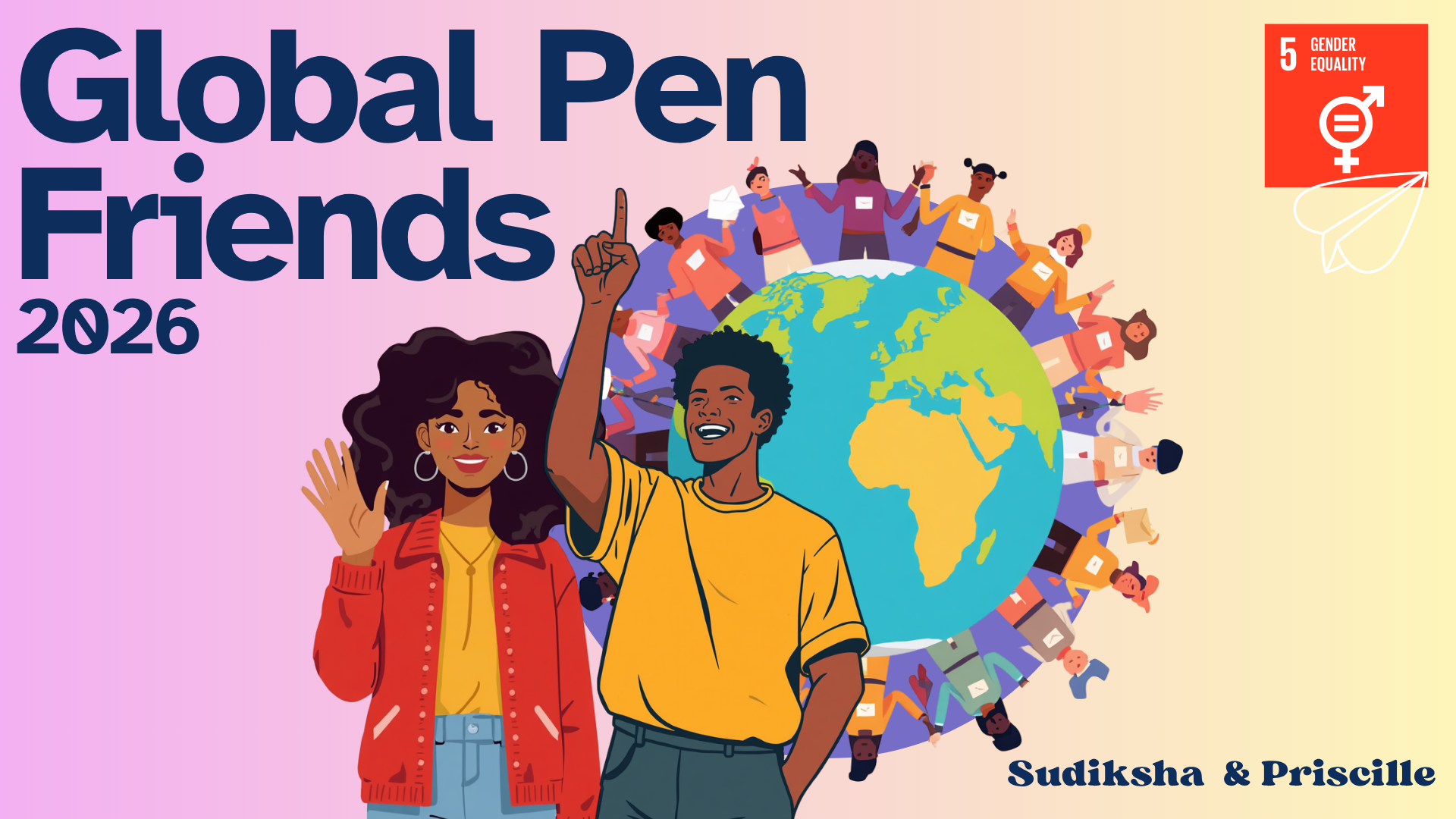
This letter exchange between two students from India and the Democratic Republic of Congo explores gender inequality through everyday experiences, cultural practices, and personal insights. It highlights shared challenges such as dowry, limited opportunities, and rigid gender roles, while emphasizing the need for both legal reforms and mindset shifts to achieve meaningful, inclusive, and lasting social change.
LETTER 1
SUDIKSHA KUMARI
Dear Priscille,
I hope this letter finds you well. This is Sudiksha, your pen pal from India. I’m really excited that we’ve been paired to discuss SDG 5: Gender Equality, and I’m looking forward to learning about your perspectives and experiences in DR Congo.
Gender equality is a topic that deeply interests me, as I identify as a feminist and often find myself observing everyday interactions through that lens. I am currently pursuing a Bachelor’s degree in Sociology, a field that focuses on understanding society and social relationships. Within this, gender is a very important area of study, which has made me even more curious about how different societies understand and experience gender roles and equality.
I am especially interested in learning how gender is shaped by culture, traditions, and everyday life in your community, and how these factors influence the way people think about equality.
When I think about how gender inequality shows up around me, it is not always very loud. Many families here have a strong preference for male children, and it is painful to see girls being treated differently within their own homes. Working part-time at my mother’s shop in Ranchi, my birthplace, I often interact with different people and get to observe these everyday realities closely.
I have noticed small but noticeable differences in the way people talk about and treat children. For instance, conversations around investing in a boy’s education are often more serious and future-oriented, while for girls, it is sometimes seen as optional or secondary as they are considered “Paraya Dhan” literally “another’s money or property” or a daughter who leaves the house of her parents when getting married. There are also casual remarks about how girls should learn household work early, as if their primary role is already decided for them. These may seem like small things, but over time, they shape how girls see themselves and what they limit what they are capable of.
Apart from these micro acts of gender discrimination that I’ve seen around myself, one issue of great concern is the fact that marital rape is not fully recognized in India in the same way as other forms of sexual violence. Which means that a husband cannot generally be charged with rape for non-consensual sex with his adult wife. This reflects how women’s consent can be overlooked within a marriage and further shows how gender inequality is not only social or cultural, but also can be institutionally structured into a society.
At the same times, there are also laws that aim to protect women, such as the criminalization of dowry, which is a practice where money, gifts, or other valuables are demanded by the groom’s family during marriage from the bride’s family. Dowry in India is not just a gift expected by the bride’s family, rather it is forced by the society, and the bride’s family is left with no options than to give into the demands because of the fear of their daughter left unwed. Dowry, in my opinion, is one of the core factors sustaining gender inequality in India. The pressure of dowry can be so intense that, from the moment a daughter is born in a family, the family may begin to save up for her future marriage. This can sometimes result in a subtle sense of burden or resentment that is created for the daughter in the family and hence leads to those micro acts of gender discrimination I mentioned earlier.
Even though dowry is prohibited in India, the ground reality is way different from that. Dowry, around me is mentioned very casually in conversations and even in some communities there are rituals in marriage that are solely based around boasting the amount of dowry they have given or received during the marriage. One sociological term that I can use to describe this is “cultural lag”. Cultural lag is a social phenomenon in which non-material culture (such as values, beliefs, norms, and attitudes) fails to keep pace with changes in material culture or social institutions, resulting in a period of maladjustment or social disorganization. The situation with dowry in India is a perfect example of cultural lag. Even though the law clearly prohibits it, the mindset of people has not changed at the same pace. Dowry is still seen as a normal part of marriage in many places, which makes it difficult for families to question or resist it.
At the same time, I do feel that the situation is slowly changing. There is growing awareness around gender equality, especially among younger people. More girls are continuing their education, becoming financially independent, and questioning traditional expectations. Conversations around topics that were once considered uncomfortable or “private” are now becoming more open and visible.
While change is not happening everywhere at the same pace, and many challenges still remain, there is a sense that people are beginning to rethink long-standing practices and beliefs. Even small shifts in mindset can make a difference over time, and I think these changes, though gradual, are important signs of progress.
I would really love to hear your thoughts on this. How is gender equality experienced in your daily life? Are there any expectations placed on girls in your community that stand out to you? Do you feel that things are changing among younger people where you live? I’m also curious to know how you think real change happens, do you feel it comes more from laws, or from changes in people’s mindsets? I’m really looking forward to hearing your thoughts and learning more about your experiences.
Warm regards,
Sudiksha
LETTER 2
PRISCILLE PLAMEDI MATALA
Dear Sudiksha,
Thank you so much for your rich and touching letter. It is a real pleasure to get to know you and to discover the realities of Ranchi through your sociological lens.
Here in Bukavu, in the eastern part of the Democratic Republic of Congo, challenges related to gender equality are also very present, although the cultural nuances differ. Just like in India, the family is the foundation of our society, and it is often where the first inequalities take root. You mentioned the concept of “Paraya Dhan”; here, a similar idea sometimes exists: it is often considered that a young girl is “destined for another family.” This can discourage parents from investing in their daughters’ education, as they fear the investment will only benefit the in-laws after marriage.
In our communities, we still too often hear that a woman’s place is limited to the kitchen and motherhood. This mindset reduces a woman’s role to that of a housekeeper and a childbearer, locking her ambitions within the domestic sphere.
However, I see a major shift within my generation. Today, more and more young women in Bukavu are pursuing higher education (like myself in Economics and Management) and aspire to financial independence. But the challenge remains immense in the labor market. It is observed that in DRC, in the majority of companies, men represent about 80% of the workforce. Women are not only fewer in number, but they almost never hold high-level leadership positions. It is a daily struggle to prove that our skills are equal to those of our male colleagues. To break this glass ceiling, I believe we should implement stricter quota policies in our companies and encourage female entrepreneurship, because when women create their own opportunities, they prove their leadership capacity to the entire society.
Regarding the dowry, it is a central topic here as well. In DRC, the dowry is a sacred institution that symbolizes the alliance between two families. But similar to your example of “cultural lag,” it is sometimes diverted from its original meaning to become a heavy commercial transaction, which can give the impression that the woman is “bought,” thus reducing her decision-making power within the home. To answer your question, I believe true change must be twofold. Laws are essential for protection (such as laws on women’s inheritance in DRC), but without a deep change in mindsets, the law remains a dead letter. Change comes from education and from conversations like the ones we are having today. I look forward to hearing more from you.
Warm regards,
Priscille
LETTER 3
SUDIKSHA KUMARI
Dear Priscille,
Thank you so much for your thoughtful letter. I really enjoyed reading it, especially because it felt like despite the geographical distance between India and the DRC, many of the experiences we discussed are surprisingly similar. I also appreciate how you compared my experiences in Ranchi to your experiences in Bukavu, it is a pleasure to understand your observations through Global Pen Friend.
What stayed with me the most from your letter was your discussion about women being confined to domestic roles, limited in the kitchen and confined as a housekeeper and a childbearer. Even in India, women are often expected to balance education or careers with the full responsibility of household work, while men are rarely expected to make the same compromises. Men are appreciated as long as they suffice to the one role, on the other hand women have to manage the household as well as their work in the workplaces. It sometimes feels that society does celebrate ambitious women, but only as long as they continue fulfilling traditional expectations at the same time.
I also found your point about the labour market very intriguing, especially the lack of women in leadership positions. Comparing the situation in India, although more women are entering universities and workplaces, there is still a visible gap when it comes to positions of power and decision-making. Women often have to work harder to prove their competence, and qualities that are appreciated in men, such as assertiveness or ambition, are sometimes judged differently in women. As per my observations, on the contrary, even when women are too friendly to their surroundings and colleagues, they’re often underestimated professionally, deemed as weak or even taken for granted in many cases.
Your idea about encouraging female entrepreneurship really made me think that economic independence seems to play such an important role in changing gender dynamics within society. When women are financially independent, they are often able to make more decisions for themselves and challenge traditional expectations more confidently. At the same time, I sometimes wonder whether financial independence alone is enough if social attitudes within families and communities remain unchanged and static.
I also appreciated your thoughts on dowry and how traditions can slowly shift away from their original meaning. It reminded me again of how complicated the relationship between culture and gender can be. Certain traditions may begin with symbolic or cultural significance, but over time they can also become tools that reinforce inequality.
Something else I have been thinking about lately is how rigid gender roles can also affect men in different ways. While women often face restrictions and discrimination, men are also expected to fit into very specific ideas of mostly “toxic” masculinity. From a young age, boys are often taught to suppress emotions, always appear strong, and carry the responsibility of being the primary earners for their families. I’ve personally heard phrases like “boys don’t cry” or “don’t cry like a girl” being said to young boys, which not only invalidates their feelings but also builds future adults who are coerced to suppress their emotions by the larger society. Men here often struggle to share or show their feelings to others. I feel that these expectations can also become emotionally exhausting. In many societies, vulnerability in men is often seen as weakness, which makes it difficult for them to openly express fear, sadness, or emotional struggles. Because of this, gender equality, to me, is not only about improving the lives of women, but also about creating a society where people are not limited by rigid expectations attached solely to their gender.
I completely agree with your point that laws alone cannot create lasting change without changes in mindset. In many ways, I feel that conversations like ours are important because they allow us to reflect not only on our own societies, but also on the similarities that exist across different cultures.
Your perspective has genuinely made me think more deeply about these issues, and I’m really looking forward to continuing this conversation with you.
Warm regards,
Sudiksha
LETTER 4
PRISCILLE PLAMEDI MATALA
Dear Sudiksha,
What a joy it was to read your letter! Your response touched me deeply. It is truly fascinating and so beautiful to see how, despite the thousands of miles separating the Democratic Republic of the Congo and India, our observations and the realities of women align so strikingly. The Global Pen Friends project is such a wonderful opportunity to share our perspectives and realize that our invisible barriers are exactly the same.
Your reflection on how society only celebrates ambitious women if they continue to shoulder the full burden of domestic work resonates deeply with what I observe here in Bukavu. In fact, while girls’ education has progressed around here, patriarchal mindsets remain the invisible pillar of household management. A woman can be a university student or run her own business, but at the end of the day, the weight of the house, the kitchen, and childcare falls exclusively on her. If a man helps around the house, he is often perceived by those around him as “weak” or dominated by his wife, which pushes men to avoid these tasks to preserve their social ego. Consequently, we end up with exhausted women who have to work twice as hard just to receive half the respect.
What you said about the labor market, and how women who are too friendly are mistaken for being weak, is exactly our daily reality. In Bukavu, within power structures or even at the university, women constantly have to wear a mask of extreme toughness and authority just to prevent people from taking advantage of them. If a woman is smiling and approachable, some male colleagues immediately mistake this kindness for professional fragility or, worse, view it as an invitation to flirt. It is an exhausting mental balancing act: we are allowed no margin for error. We are either judged as “hysterical” and too harsh if we assert ourselves, or we are made invisible if we remain gentle.
Your doubt regarding whether financial independence is enough if mindsets do not evolve is incredibly spot on. In Bukavu, many women literally carry the local economy on their shoulders through small-scale trade, agriculture, or entrepreneurship. They earn the money that keeps the entire family alive. Yet, once at home, this money does not automatically grant them decision-making power. The husband, even if he is unemployed or earns less, remains the unquestionable “head of the household” according to custom and law. Financial autonomy is an indispensable weapon, but as long as men are raised to believe that their masculinity depends on domination, a woman’s income can sometimes become a source of marital tension or economic violence rather than a tool for liberation.
Finally, I was deeply moved by what you wrote regarding the suffering of men faced with “toxic masculinity”. This is a topic we discuss far too rarely. Here, from childhood, boys are told that a man is a rock, that he does not cry, and that he must never show any vulnerability. This pressure is terrible. In Bukavu, following successive economic and social crises, many men can no longer fulfill this role of sole financial provider. But because society forbids them from verbalizing their distress, fear, or sadness, this frustration often turns into a destructive silence, alcoholism, or aggressiveness. They suffocate themselves within this rigid mold. You are entirely right: gender equality is not a fight of women against men; it is a collective liberation. Men desperately need to be given back the right to be human and vulnerable.
I am holding onto your letter tightly; it gives me so much food for thought.
With all my friendship,
Priscille