

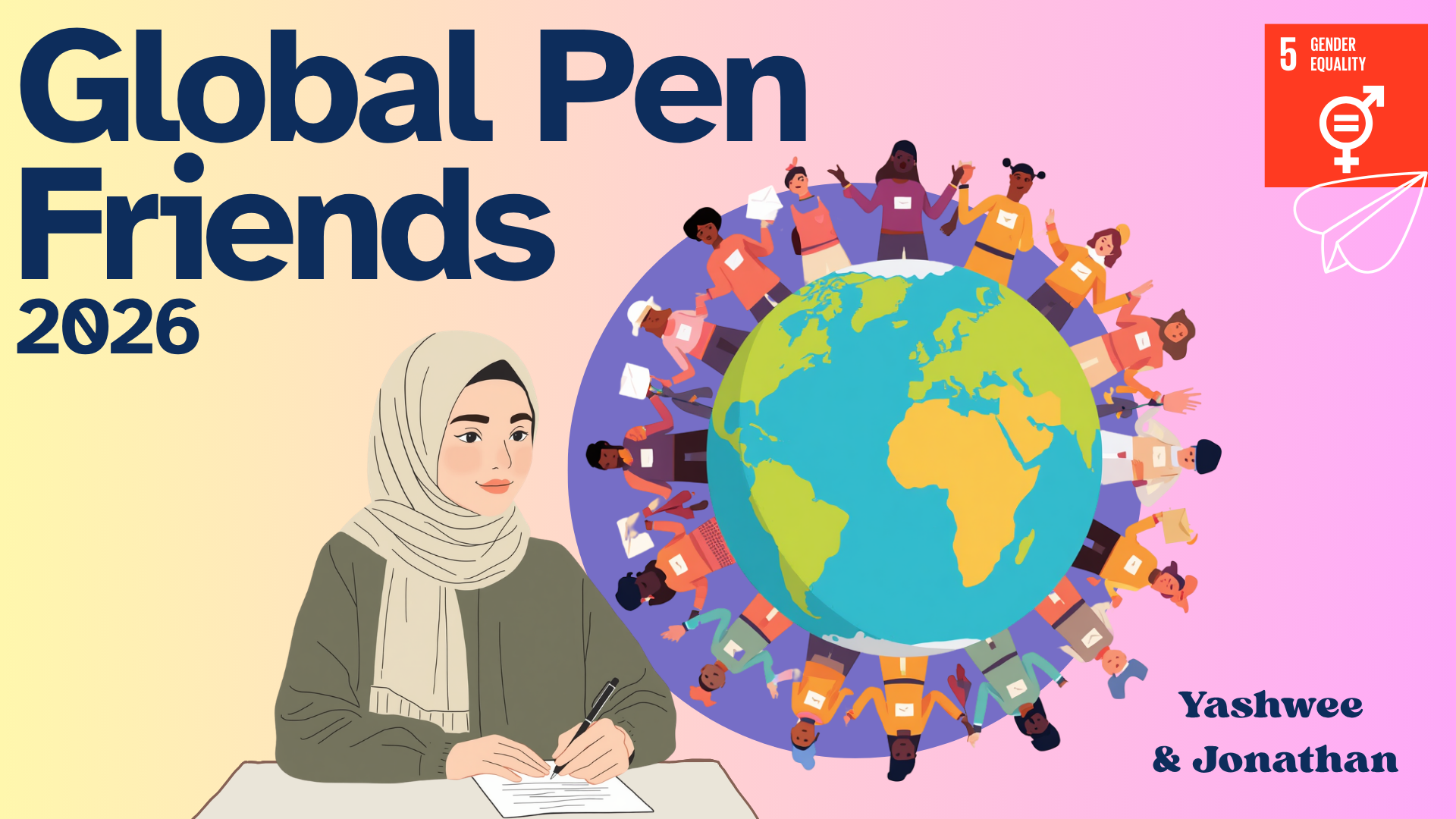
This letter exchange between two pen friends from India and the Democratic Republic of the Congo explores gender equality through deeply personal stories and lived realities. It highlights resilience, collective strength, and youth-driven change amid contrasting contexts of tradition and conflict, emphasizing the shared struggle for dignity, empowerment, and a more just future for women.
LETTER 1
YASHEE MADHUVARSHINEE
Dear Jonathan,
Greetings to you from India.
My name is Yashwee Madhuvarshinee, and I am so happy to write to you as part of this Global Pen Friends programme. It is a wonderful thing to be able to bridge the thousands of miles between us with just a few pages of thoughts. I understand that you may not be very familiar with India’s social and economic realities, so I will try to share my heart with you in simple words. My goal is to help you picture what gender equality really looks like on the ground in my country—not just as a slogan, but as a lived experience.
India is a land of deep contrasts. We are a nation of over a billion people, where the ancient and the modern live side by side. In our big cities, you will see glass skyscrapers and women leading boardrooms or coding the software of the future. But just a few miles away, you might find a village where traditions have remained unchanged for centuries. Because of this, the life of a girl in India is often decided by the family she is born into and the zip code she calls home. While some women are reaching for the stars, others are still fighting for the basic right to be seen and heard.
When I talk about “achieving gender equality,” I am talking about a world where a woman’s path is not blocked by the fact that she was born a girl. To me, “empowerment” is a beautiful word that is often misunderstood. It isn’t something we give to women like a gift. It is about removing the heavy barriers—laws, traditions, and prejudices—that prevent women from exercising their own power. It is about the freedom to make choices: the choice to stay in school, the choice of whom to marry, and the choice to earn a dignified living.
The Invisible Heart of India
To understand gender equality in India, you must first understand the “informal economy.” This sounds like a technical term, but it is actually very simple. It refers to the millions of women who work as street vendors, rag-pickers, weavers, and small-scale farmers. They don’t have fancy contracts or office badges. They work in the sun, on the streets, and in their own small homes.
For a long time, these women were invisible. Because they didn’t work in a factory or a government office, the world acted as if their labour didn’t count. But they are the backbone of our country. I have learned that a woman who sells vegetables is not just a “seller”—she is a manager, a negotiator, and a provider.
Equality begins when we recognize this work as “real” work. When we ensure these women have a bank account in their own name, or a safe place to keep their earnings, we are not just helping them; we are recognizing their dignity as economic citizens.
The Power of Being Together
One of the most important lessons I have learned is that a woman standing alone is often vulnerable. She can be ignored by a landlord, a middleman, or even her own family. But when women join together, everything changes.
In India, we have seen the incredible rise of “collectives” and cooperatives. Imagine a group of twenty women in a village who all do embroidery. Individually, they might get paid very little by a merchant who takes advantage of their poverty. But when they form a group, they gain what I call “collective strength.” They can buy their materials in bulk, they can set a fair price for their beautiful work, and they can support one another during illness or hard times.
When a woman joins a group, she stops being a “victim” of her circumstances and starts being a leader. She gains a voice. And once a woman finds her voice, she never lets it go.
The Double Burden of Work
We cannot talk about equality without talking about what happens inside the home. In India, as in many parts of the world, there is an invisible weight that women carry called the “double burden.”
A woman might spend eight hours working in a field or selling goods, but her work does not end when the sun goes down. She returns home to cook, clean, fetch water from a distant well, and care for the elderly and the children. This “unpaid care work” is often taken for granted.
True equality means shifting the mindset of our men and our society. We are working toward a day where a father feels as much pride in nurturing his children as he does in providing for them. When the load at home is shared, the door to the world outside swings open for women. It gives them the most precious thing of all: time. Time to learn, time to lead, and time to rest.
The Digital Revolution
You might be surprised to know how much technology is changing the lives of rural Indian women. Even in remote areas, the smartphone has become a tool of liberation.
I recently met a woman who used to travel for hours just to pay a utility bill or deposit a few rupees in a bank. Now, she does it with a tap on her phone. Technology allows her to bypass the people who used to exploit her. She can see the market prices for her crops in real-time, so no one can cheat her. She can join online groups to learn new skills. For her, that small plastic device is a gateway to independence that her mother could never have imagined.
The Journey Ahead
Of course, I must be honest with you—the road is still long. We still struggle with the tragedy of early marriage, which steals the childhood and the potential of many young girls. We still worry about the safety of women in our public spaces, which limits their freedom to move and work.
But as I sit here writing to you, my heart is full of hope. I see it in the eyes of the young girls who are walking miles to reach their schools, clutching their books as if they were gold. I see it in the grandmother who is learning to sign her name for the first time. I see it in the fathers who are standing up against old traditions to support their daughters’ dreams of becoming doctors, pilots, or teachers.
The direction of India is forward. We are moving from a world where women were “allowed” to exist to a world where they are expected to lead. We are realizing that gender equality is not a “women’s issue”—it is a human issue. When a woman is empowered, her children are healthier, her village is more prosperous, and the whole nation stands taller.
I would dearly love to hear about your country. How do women there find their voice? What are the traditions that you are keeping, and which ones are you changing? We may live in different parts of the globe, but I believe the sisterhood of women and the friendship of those who seek justice is a language that needs no translation.
I look forward to our journey as pen friends.
With warm regards and friendship,
Yashwee Madhuvarshinee
LETTER 2
TOMOTHEE JONATHAN BWINJA
Dear Yashwee,
It is with profound emotion that I receive your words from India. Reading your letter, I felt as though our hearts, though separated by the Indian Ocean and thousands of miles, beat to the same rhythm: the quest for dignity. Here in Bukavu, on the shores of Lake Kivu, life is a complex melody where the beauty of the landscape contrasts sharply with the harshness of the war surrounding us.
Like you, I live in a land of contrasts. The Democratic Republic of the Congo is a giant in the heart of Africa. But here in the East, the word « equality » is not only conjugated in the future tense ; it is conjugated in the present, driven by the urgency of survival. If in India, a girl’s destiny depends on her zip code, here, it often depends on the front line. Yet, amidst the chaos, Congolese women are the true architects of peace.
You spoke of the « informal economy » in India, and it resonated within me like a familiar echo. Here in Bukavu, it is our « Mamans Mapendo » and the vendors of the Kadutu market who keep the country standing. While factories are rare and war disrupts the State, it is the women who cross borders and conflict zones to bring back what is needed to feed their children.
In the DRC, equality begins with the recognition of courage. A woman who tills her field despite the threat of armed groups is not just a farmer ; she is a resistance fighter. Like your vegetable vendors, our women are strategists of the invisible. For us, empowerment is the transition from survival to stability. When a woman here owns her own plot of land or her small business, she doesn’t just feed her family—she secures a piece of our nation.
Your idea of « collective strength » is our most powerful reality. In a war zone, a woman alone is a target. But together, they become a fortress. We have « Village Savings and Loans Associations » (VSLA) here—circles of trust where women pool their meager savings to help one another.
I have seen women displaced by war, having lost everything, rise again thanks to these collectives. They don’t just share money ; they share their traumas to transform them into strength. When a woman in Bukavu finds her voice, she doesn’t just speak for herself ; she cries out for justice and for an end to violence. It is this sisterhood that prevents our society from collapsing.
You mentioned the « double burden, » and I must add that here, we often carry a triple burden. To the cooking, cleaning, and raising of children, we add the weight of insecurity. In times of war, fetching water or firewood is an act of bravery, for a woman’s body is too often used as a battlefield.
For us, equality also means the right to physical safety. We dream of a world where « protecting » does not mean « locking up » women, but transforming the mindset of men. We see more and more young boys here who understand that a man’s strength is measured by his respect for his sister’s rights. The « rest time » you spoke of is our ultimate luxury—one we hope to conquer through peace.
Just as in India, the digital revolution is reaching us. Despite power outages and connectivity challenges, the mobile phone has become a weapon for peace. Women use it to report abuses, to check the prices of coffee or minerals, and to stay connected to the world.
But my greatest hope lies in the classrooms of the University of Bukavu. To see young girls studying economics or law, while the sound of gunfire can sometimes be heard in the distance, is a lesson in humility. They do not see their studies as a mere degree, but as a passport to rebuild the Congo.
Yashwee, the road is long for us too. We fight against forced marriages and the scars left by decades of conflict. But like you, my heart is full of hope. I see it in the resilience of our mothers who, after losing everything, start from scratch with a smile that defies fear.
India is moving forward, and the DRC, despite its wounds, refuses to stay on its knees. We are moving from a culture of victimization to a culture of female leadership. For we have understood that if war has torn this country apart, it is the women who will sew it back together, stitch by stitch, with the thread of equality.
I am eager to continue this exchange with you. Tell me, how does the Indian youth see their role in this change ? Here, we believe that friendship is a light that pierces through the clouds of war.
With all my friendship and fraternity,
Jonathan Bwinja Timothée
Ps: I have used AI for a traduction to this letter .
LETTER 3
YASHEE MADHUVARSHINEE
Dear Jonathan,
I had to sit quietly for a long time after I finished reading your letter. I am not embarrassed to tell you that my eyes were filled with tears. I was truly overwhelmed with emotion. The world you described — the Mamans Mapendo carrying their goods across conflict zones, the women of Bukavu who step out each day knowing the dangers that surround them, the young girls studying economics with the distant sound of gunfire as their backdrop — it stirred something very deep in my soul. My heart goes out to every single one of those women. The struggles you described were not just words on paper to me. They felt achingly real, because courage like that reaches across any distance.
Jonathan, your letter was beautifully written. You painted a picture of immense resilience — the kind that does not shout or demand applause, but quietly and steadily rebuilds what has been broken. The sisterhood you described, where women share not just their savings but also their deepest wounds, moved me profoundly. It reminded me of something I hold close: when strong-willed women come together, there is truly nothing they cannot achieve. Whether in the Congo or in India, the spirit of women who refuse to be defeated is one of the most powerful forces on this earth.
You asked how Indian youth sees their role in this change. I want to answer that honestly and fully. But let me first share a little more of the ground reality here in India, so you can understand the soil from which our young people are growing.
India is a land of enormous contrasts, and nowhere is this more visible than in the lives of its women. Let me tell you about three women I have personally met, because I think their stories will tell you more than any statistic ever could.
The first is Savitri, a woman in her thirties from a village here in Bihar. She was married at sixteen — far too young, and against the law, but it happened quietly, as these things often do. She never finished school. She works in the fields, tends to her children, and cooks on a wood-fire stove. She does not own any land in her name, even though she has worked on it her entire life. When I asked her what equality means to her, she looked at me with patient, steady eyes and said, “It means not having to ask permission to step outside my own door.” That sentence stayed with me for days.
The second is Meena, a woman in her forties from Tamil Nadu in South India. She joined a Self-Help Group — a small circle of women from her village who pool their savings together, much like your Village Savings and Loans Associations. Through a small loan from the group, Meena started a tailoring business. Today, she employs four other women from her neighbourhood. She told me, “When I had my own money, my family started listening to me.” One sentence. Everything it means to be financially independent, said simply and completely.
The third is Priya, a twenty-two-year-old from Mumbai who is studying engineering. She is the first girl in her family to go to university. In her department, women are a minority, and she often has to work twice as hard to be taken half as seriously. But she is there. She shows up every single day. And she is far from alone.
These three women represent the distance India has to travel — from Savitri’s village to Priya’s college. And it is in that distance that the youth of our country are finding their purpose.
Jonathan, when you asked about Indian youth, I smiled, because this is where my hope lives. Something is shifting in our generation, and it is visible if you know where to look.
The Indian youth, especially the young people from cities and from educated families,are increasingly rejecting the old ways. You see it in the young men who take their wives’ ambitions as seriously as their own. You see it in the college students who march for women’s safety and demand accountability from institutions. You see it in the young women who refuse arranged marriages they do not want, who choose their own professions, and who speak up on social media about injustice.
Let me tell you about Arjun, a twenty-five-year-old from a small town in Rajasthan. When his younger sister was pressured by their extended family to drop out of school after class ten, it was Arjun who stood up at a family gathering and refused to let it happen. He told his uncles and grandparents, with quiet but firm words, that his sister would finish her education. He then cycled her to school every morning for two years until she cleared her board exams. Today she is in college, studying to be a nurse. Arjun told me later, “I was not doing anything special. I was just doing what was right.” That is the voice of a generation that no longer accepts the old ways as inevitable.
Then there is Kavita, a twenty-year-old college student in Delhi who started a small initiative in her neighbourhood to teach young girls from nearby slums basic digital literacy — how to use a smartphone safely, how to access government schemes, how to look up information online. She does this on weekends, on her own time, with borrowed tablets and a lot of patience. She told me, “These girls are so smart. They just need someone to open the first door.” Kavita is not an NGO. She is not funded by anyone. She is simply a young woman who looked around her and decided that she could do something.
And then there is Riya, a nineteen-year-old from a village in Uttar Pradesh, who became a “Saheli” — a peer educator trained under a government programme to speak to other adolescent girls about their rights, their health, and their choices. Riya herself had almost been married off at seventeen. She ran away to her school teacher for help, and that teacher changed everything. Now Riya goes door to door in her village, sitting with mothers and daughters, talking about why girls must be allowed to finish school before they are married. She has so far convinced three families to postpone their daughters’ weddings. Three families. Three girls whose futures are now open.
These stories are not exceptions, Jonathan. They are part of a growing wave. The challenge, however, is the divide between urban and rural youth. Young people in cities have access to education, the internet, and exposure to diverse ideas. Young people in villages are still shaped by the traditions of their communities. This is where the real work lies, in building bridges between these two worlds.
There is also a powerful movement happening in our schools. The government’s “Beti Bachao, Beti Padhao” programme which means “Save the Daughter, Educate the Daughter” has worked to improve girls’ enrolment and retention in schools. The female literacy rate in India has risen from around 39% in 1991 to nearly 71% today, according to census data. That is far from perfect, but it represents tens of millions of girls whose lives are different because they could read. According to the National Family Health Survey (NFHS-5), the proportion of women aged 20-24 who were married before eighteen has dropped from 47% in 2005 to around 23% in 2021. That is still far too high, but the direction of change is real. It is the result of millions of small acts of courage, by young people like Arjun, Kavita, and Riya, happening every day across this vast country.
Jonathan, what you shared has expanded my understanding of what it means to fight for gender equality. In India, our battle is largely against tradition, poverty, and mindset. In Bukavu, your battle is against all of that, and also against the gun. And yet, the women of your country have not given up. That is not just brave — that is extraordinary.
Your description of the classroom at the University of Bukavu, young girls studying law and economics while guns echo in the distance, reminded me of a verse from a poem by the great Indian poet Rabindranath Tagore, who believed that education is the torch that no darkness can extinguish. In India, in Congo, in every corner of this world, women are carrying that torch, even when their arms are tired.
We often talk about women as if they need to be saved. But from what I have seen, both here in India and now through your words from Bukavu, is that women are most often the ones doing the saving. They save their families. They save their communities. And if we give them the space and the tools, they will save nations.
I will not paint a picture that is rosier than it is. India still ranks 129th out of 146 countries in the Global Gender Gap Report 2024. The gap between what the law promises and what life delivers is still very wide. Young women in cities enjoy freedoms that women in villages can barely imagine. And the burden of unpaid work at home; the cooking, the cleaning, the caregiving, still falls overwhelmingly on women, limiting the time and energy they have for their own ambitions.
But what gives me hope is that the young people of India are increasingly unwilling to accept this as simply “how things are.” They are asking harder questions of their families, their institutions, and themselves. They are finding quiet, stubborn, everyday ways to push back. And they are doing it not with anger, but with a deep belief that equality is not a favour extended to women — it is something that belongs to them.
Your letter has reminded me that this struggle is not India’s alone. It belongs to every country where a woman has had to fight for what should have been hers by birth. The women of Bukavu and the women of Bihar are separated by thousands of miles and very different realities. But in their refusal to give up, they are the same. And I believe that as long as there are young people, on your shores and mine, who are willing to stand beside them, the direction of this world is forward.
I think of the women in Bukavu’s savings circles. I think of the women in Bihar’s Self-Help Groups. I think of Savitri, Meena, and Priya. And I think of your mothers who, as you so beautifully said, “start from scratch with a smile that defies fear.” These women are not statistics. They are the heartbeat of our respective nations.
Thank you for writing to me, Jonathan. Thank you for trusting me with the truth of your world. This pen friendship has already taught me more than I expected. Before I end this letter, I want to leave you with a question that has stayed in my mind for a long time: “If women are already carrying so much of the world on their shoulders, imagine how different the world could become if they were finally allowed to lead it equally?”
I am eagerly looking forward to your next letter.
With warmth, hope, and friendship across the miles,
Yashwee Madhuvarshinee
LETTER 4
TOMOTHEE JONATHAN BWINJA
Dear Yashwee,
I read your letter with great attention and emotion. Your words touched me deeply. Through the stories of Savitri, Meena, Priya, Arjun, Kavita, and Riya, I discovered an India that statistics alone cannot describe. Behind every number lies a life, a struggle, and a hope. Thank you for sharing these realities so sincerely.
Your letter also led me to reflect more deeply on the situation in my country, the Democratic Republic of the Congo, particularly on the lives of women and young people in the eastern provinces, where insecurity has unfortunately been part of daily life for decades.
When people speak about the DRC abroad, they often mention its immense natural resources, forests, or cultural richness. Yet for millions of Congolese, reality is also marked by armed conflict, displacement, and constant uncertainty. In my region, many families wake up each morning without knowing what the day will bring.
I think of Chantal, a displaced woman I met in a camp near Goma. Before attacks forced her from her village, she owned a small business that enabled her to feed her children. In a single night, she lost everything. Today, she lives under a tent with her family. Yet every morning she rises before sunrise to sell a few vegetables in the camp’s makeshift market. When I asked her where she found the strength to continue, she simply replied, “If I stop, my children will go hungry.”
I also think of Grâce, an economics student at university. Despite clashes occurring only a few kilometers from her home, she continues her studies with determination. Some days classes are disrupted by insecurity. On other days, transportation becomes dangerous. Yet she refuses to abandon her dream of contributing one day to the development of her country.
There are also the Mamans Mapendo, as we often call them here. These are women who walk for miles to sell agricultural products. They travel roads where safety is never guaranteed. They carry not only their goods on their shoulders but also the survival of their families.
The current security situation in eastern DRC remains deeply concerning. Armed groups continue to operate in several territories of North Kivu, South Kivu, and Ituri. Their activities regularly trigger massive population displacements. Thousands of children are growing up far from their villages under difficult conditions, with limited access to education and healthcare.
And yet, despite this reality, young Congolese people refuse to surrender to despair.
I know students who organize awareness campaigns promoting peace. Others establish small associations to assist displaced people or support the education of vulnerable children. Many use social media to denounce injustice and give a voice to those living in conflict-affected areas.
I think of Patrick, a young graduate who created a local initiative offering free lessons to displaced children. He has neither major funding nor an international organization behind him. He simply has a blackboard, a few notebooks, and the conviction that education remains more powerful than violence.
As you highlighted about India, our youth are also challenging realities that previous generations often considered inevitable. We refuse to believe that war must define the future of our region. We refuse to believe that young people are destined to inherit conflict instead of building peace.
The difference is that our challenges go beyond poverty and traditions. They also include insecurity, forced displacement, and sometimes fear. Yet despite all this, we continue to study, work, innovate, and hope.
What gives me the greatest hope are the women of my country. Like the women you described in India, they are often the silent pillars of our communities. They rebuild what violence destroys. They feed families when resources are scarce. They encourage their children to pursue education even when everything seems lost.
Through your letter, I realized that the challenges of India and those of the DRC are different, yet they share a common thread: everywhere, women and young people refuse to give up their dignity and their future.
I believe true change is born when ordinary people perform extraordinary acts of courage every day. Whether in a village in Bihar, on the streets of Mumbai, in Bukavu, or in Goma, that same human strength continues to shine.
Thank you, Yashwee, for this wonderful friendship built through our letters. It reminds me that beyond borders, cultures, and languages, we share the same hopes: to live in peace, to offer a better future to our communities, and to build a fairer world for the generations that follow.
With all my friendship and warm greetings from the Democratic Republic of the Congo,
Jonathan