

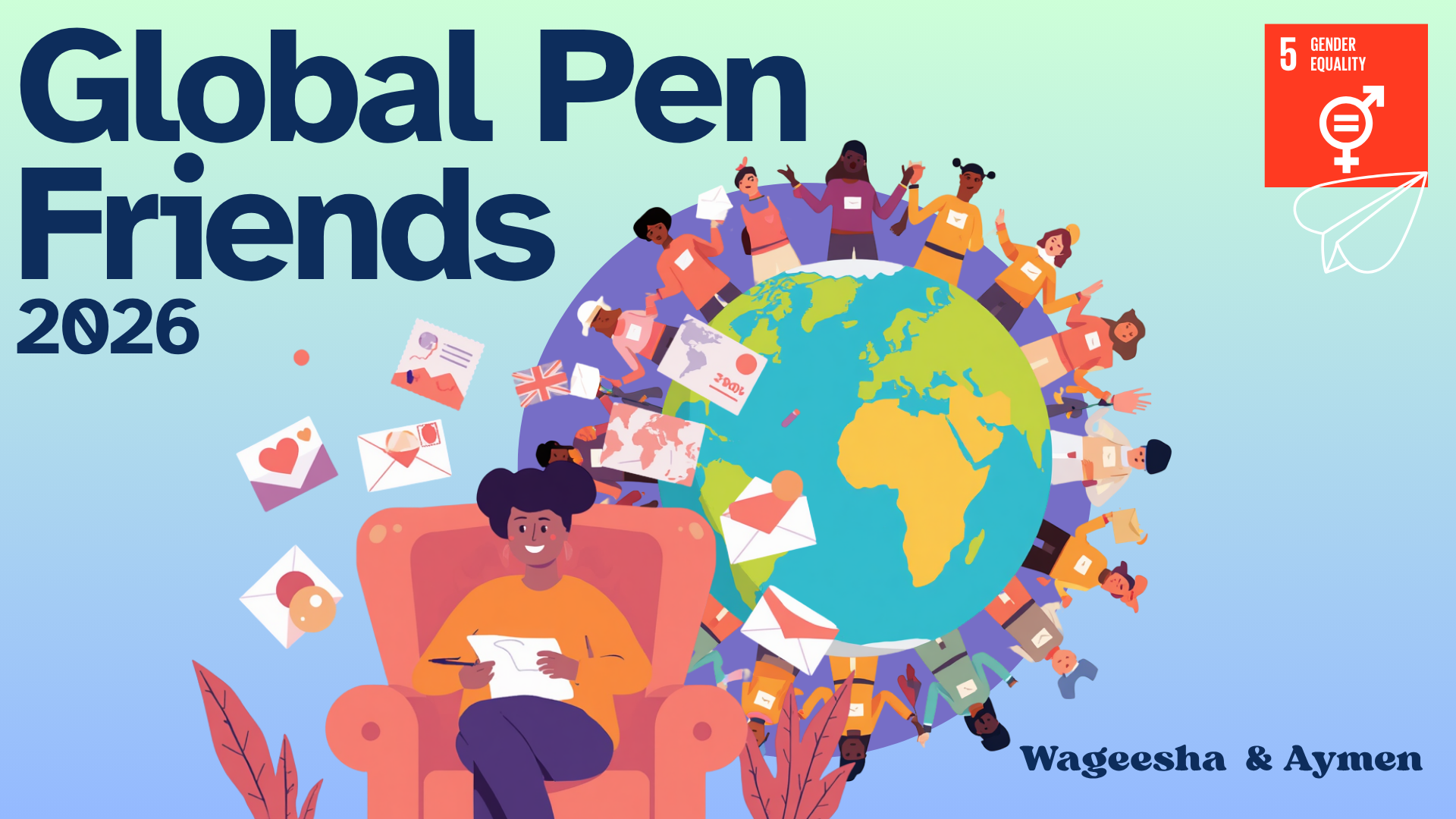
This letter exchange between two students from India and Morocco explores gender equality through cross-cultural reflection and lived experiences. It highlights progress alongside persistent societal norms, uncovering subtle and systemic inequalities in education, healthcare, and daily life. Through thoughtful dialogue, both correspondents emphasize the transformative role of awareness, representation, and youth engagement in advancing women’s empowerment globally.
LETTER 1
WAGEESHA SHRI
Dear Aymen,
I hope you are doing well. I feel really happy that through the Global Pen Friends program we got the chance to connect with each other and exchange our thoughts on such an important topic as gender equality. I think conversations like these help us understand not only our own societies better but also the different realities people experience around the world.
When I think about gender equality, I don’t see it only as a legal or political idea. For me, it is something very personal and visible in everyday life. It is about whether girls feel safe while traveling alone, whether boys are allowed to express their emotions without being judged, whether families support daughters’ education the same way they support sons’, and whether people are respected equally regardless of their gender.
In India, gender equality is both a promise and a process. On paper, our Constitution gives equal rights to everyone. From school time itself, we learn that discrimination on the basis of gender is not allowed and that both men and women should get equal opportunities in education and jobs. Even today, when I think about it, it makes me feel proud that equality is considered such an important value in our country’s foundation. But at the same time, I also feel that real equality is something society is still working toward step by step.
If I look around in my own surroundings, I can see that many things have changed compared to earlier generations. Today, girls are encouraged to study, travel to different cities for higher education, and dream about careers in fields that were earlier considered only for men. Women are becoming doctors, scientists, officers, athletes, and political leaders. In many families, parents now believe that daughters should be independent and confident. I personally find this change very inspiring.
At the same time, I also feel that some traditional expectations still exist. For example, in many households, girls are still expected to manage most of the domestic responsibilities even if they are studying or working. Sometimes people unknowingly treat sons and daughters differently while making decisions about education or freedom. These things may look small individually, but together they show that gender equality is still a journey in progress.
One thing that I really appreciate about India is that there are many laws made to protect women’s dignity and safety. For example, there are laws against domestic violence and harassment in workplaces (such as the POSH ACT of 2013), and there are also efforts to ensure equal pay and equal opportunities. Women are also given reserved seats in local political bodies like Panchayats, which helps them participate in decision-making at the grassroots level. I feel these steps are important because they not only provide protection but also encourage confidence and leadership among women.
As a student, I personally believe education plays the biggest role in bringing gender equality. When girls are educated, they become more aware of their rights and more confident in expressing their opinions. At the same time, boys also grow up learning respect and understanding, which helps create a balanced society. In my opinion, equality is not something that can be achieved only through laws but it also depends on how people think and behave in daily life.
Another thing I have noticed is that awareness among young people in India is increasing very quickly. Through social media, classroom discussions, and public campaigns, students today are more open to talk about gender issues than before. Many young people support equal opportunities and speak against discrimination. I feel hopeful when I see this because it shows that our generation can bring real change in the future.
At the same time, there are still challenges that cannot be ignored. Safety concerns, early marriage in some areas, unequal access to opportunities in rural regions, and social pressure on both boys and girls are still realities in parts of the country. But I believe acknowledging these problems honestly is the first step toward solving them. Change takes time, especially in a diverse country like India where traditions and modern ideas exist together.
Personally, I feel that gender equality is not only about women’s empowerment but also about creating a society where everyone feels respected and valued. It also means allowing people to choose their careers, lifestyles, and responsibilities freely without being judged based on gender. I think if equality starts in families and schools, it can naturally spread throughout society.
Since this program is about sharing experiences, I am really curious to know about the situation in your country as well. How do people there understand gender equality? Are students actively involved in discussions about this topic? Do families encourage equal opportunities for boys and girls in the same way? I would really like to learn about your experiences and observations.
I truly believe that exchanges like ours help build understanding between cultures and make us more responsible global citizens. I am looking forward to hearing your thoughts and learning more about your country through your perspective.
With warm regards,
Wageesha
Your pen friend from India
LETTER 2
AYMEN BENNANI
Dear Wageesha,
I hope my words find you perfectly healthy and happy! Thank you for taking the time to share with me your input about gender equality and women’s status in India.
I read your letter with great interest and was deeply moved to learn about the various laws protecting women in India from violence and harassment, as well as the increasing awareness among young people and their active engagement in promoting gender equality and combating discrimination. Your letter also particularly resonated within me because it reminded of something I came across recently, which you might find exciting. I am a chess fan and the FIDE Candidates tournament has just wrapped up with the crowning of the Indian Grandmaster Vaishali Rameshbabu as the challenger for the Women World champion title. The chess fans all over the world celebrated her great achievement, but I was particularly happy to see her getting the recognition she deserves within the Indian chess community, and I hope her success will inspire and enable more young girls to play professional chess, a field that was, and to an extent still is, very male-dominated.
In Morocco, the picture is in many ways similar to what you described. Women have made remarkable strides; you will find them today as judges, ministers, doctors, and engineers, in roles that were simply not open to them a generation ago. Seeing that fills me with genuine pride, because it shows that what women needed all along was not permission, but opportunity. That said, the process is still ongoing and there is room for improvement; per example, although women’s presence has increased in the government, parliament, and provincial councils, they are still less represented than men.
One thing your letter made me reflect on is how gender disparities often hide in plain sight, even in spaces we consider progressive. As a medical student, I witness them even in my surroundings. I remember last week, I had a conversation with a fellow medical student about career choices. She is a brilliant student with an amazing potential, and she is very passionate about surgery. However, during the conversation, she casually mentioned that she had already crossed certain surgical specialties off her list, simply because they are considered “not suitable for women”. That moment stayed with me. She had not been told no by anyone directly, but the message had still gotten through. Gender inequality does not always announce itself loudly; sometimes it quietly shapes the choices people feel they are even allowed to make.
This is something I also think about a lot in the context of healthcare itself. One illness that comes to my mind is endometriosis, a chronic condition that causes debilitating pain, typically during menstruation. Because menstrual pain is often dismissed or normalized, it takes many years (4 to 12 according to the World Health Organization) for young women to get proper investigation and diagnosis. Another challenging condition is fibromyalgia, which causes chronic, severe widespread pain, with no laboratory test to confirm it. Since its diagnosis is primarily clinical, many women have hard time accessing treatment and insurance coverage. Both of these situations reflect a healthcare system that was not always built with women’s experiences in mind, and changing that requires not just better science, but a shift in how we listen.
So, what can be done? I find myself coming back to a few ideas.
At a national level, I think one of the most underrated things we can do is recognize women’s contributions more consistently, not just on International Women’s Day, but in everyday life and education. Growing up, I learned a great deal about the men who led Morocco’s independence movement, but it was only much later that I started discovering how much women contributed to that same fight. If those stories had been part of our school curriculum from the beginning, I think it would have shaped how we all understood what women are capable of. As you so rightly put it, education really is the foundation of everything.
The situation in rural Morocco also weighs on me. There are still far too many young girls who drop out of school early because of financial hardship, distance, or family pressure. I agree with you that change takes time, but some of these girls simply cannot afford to wait for slow, generational progress, which is why targeted support to help young girls finish their education without worrying about financial issues or outdated societal ideologies has to be a real priority, not just a talking point.
On a local level, in my medical school, I am proud to say that many clubs are actively advocating for gender equality and women empowerment. We also have trainers certified by IFMSA (the International Federation of Medical Students Associations) who deliver workshops on human rights, gender related violence and discrimination, and equality. Events focused on women’s health are also organized regularly, both for future healthcare professionals and for the wider community. Being part of that environment keeps me hopeful.
All in all, I think Morocco and India share common ground in this journey, between pride in how far we have come and honesty about how far we still have to go. I hope our exchange can help shape the vision necessary to draw the path. In your next letter, I would love to hear your feedback on the points I raised, and of course learn more about the situation in India.
I am truly grateful for this exchange. There is something valuable about sitting down and thinking carefully about the world you live in, and there is even greater value when someone from the other side of the globe is reflecting alongside you. I very much look forward to our next correspondence.
Kindest regards,
Aymen
Your pen friend from Morocco
LETTER 3
WAGEESHA SHRI
Dear Aymen,
I hope you are doing well. I was genuinely happy to receive your letter and read your thoughts so carefully. I found your letter very thoughtful and insightful, especially the way you connected your own experiences with the larger issue of gender equality in Morocco. Reading your perspective helped me understand the situation there in a much more personal and realistic way rather than just through general information or assumptions.
Your example of Vaishali Rameshbabu really stood out to me. As someone from India, it made me feel proud to see an Indian woman being recognized internationally, but more than that, it reminded me how important representation truly is. When women succeed in fields like chess, science, sports, or politics, they do much more than achieve personal success. They slowly challenge stereotypes that society has held for years. Young girls who see such examples begin to believe that they are capable of achieving those things too. In India, we are seeing more women coming forward in different fields today, and although change is gradual, these examples are definitely influencing people’s attitudes and inspiring a younger generation to think differently.
At the same time, I completely agree with your observation that gender inequality often exists in subtle and indirect ways. The example you shared about your fellow medical student felt very relatable to me because many girls in India experience something similar while growing up. Even when families appear supportive, there are often unspoken expectations and invisible boundaries that shape girls’ decisions. Many girls are made to feel that they should prioritize family responsibilities over ambition, avoid careers considered “too demanding,” or behave in ways society considers “appropriate.” These ideas are not always said openly, but they become deeply internalized over time. Because of this, many women start doubting themselves before even trying. So I feel that in both India and Morocco, one of the biggest challenges is not only creating opportunities for women, but also changing the mindset that limits them from within society itself.
However, I would also say that the situation in India is very complex and layered because of the country’s diversity. In many urban areas today, women are becoming financially independent, highly educated, and actively involved in professional spaces. More women are entering politics, corporate jobs, law, medicine, and other sectors that were once male-dominated. At the same time, in many rural areas, issues like early marriage, lack of educational opportunities, financial dependence, and social restrictions still continue. Sometimes even basic education for girls is not prioritized. This creates a huge contrast within the same country. While reading your letter, I felt that Morocco may also be experiencing a similar phase of transition, where progress is happening, but traditional social expectations still continue to influence people’s lives in many ways.
Your discussion about healthcare inequalities was particularly eye-opening for me. Reading about conditions like endometriosis and fibromyalgia made me realize how deeply gender bias can exist even within medical and scientific systems. In India too, women’s health, especially menstrual and reproductive health, is often treated as something uncomfortable or shameful to discuss openly. Because of this, many women ignore symptoms for years or hesitate to seek medical help. In some families, pain experienced by women is normalized and dismissed rather than taken seriously. This delay in diagnosis and treatment affects both physical and mental health. I think this clearly shows that gender inequality is not limited to education or employment alone; it also affects how women’s pain and experiences are perceived by society.
Another thing I reflected on while reading your letter is how awareness alone is sometimes not enough. In India, many laws and schemes exist to support women’s rights and education, but their implementation is often uneven. Due to the country’s large population, cultural diversity, and economic differences, progress reaches different communities at different speeds. In some places, people are becoming more aware and accepting of gender equality, while in others traditional thinking still strongly influences daily life. This makes the issue more complicated because social change cannot happen only through policies; it also requires continuous education, discussion, and change in people’s attitudes.
I also appreciated your point about recognizing women’s contributions in education. I strongly agree that textbooks and educational systems often focus more on male leaders and historical figures, while women’s achievements receive comparatively less attention. When students grow up without learning about influential women in history, science, literature, or politics, it unconsciously shapes their understanding of gender roles. Including more stories of women’s contributions can help create a more balanced perspective for future generations and encourage girls to see themselves in leadership roles as well.
Your mention of rural girls dropping out of school in Morocco resonated with me deeply because similar issues still exist in many parts of India. Even today, some girls discontinue their education because of financial problems, household responsibilities, safety concerns, or social expectations regarding marriage. Distance from schools and lack of proper facilities also become barriers in many rural areas. What makes this issue more concerning is that education is often the first step towards independence and empowerment. When girls lose access to education, many other opportunities automatically become limited for them as well. That is why I completely agree with you that these issues require immediate attention and cannot simply be left for slow social change over time.
I was also very happy to learn about the initiatives taking place in your medical school. It is genuinely inspiring to see students and young people actively participating in discussions and actions related to gender equality. I feel that our generation has an important role in bringing social change because we are more exposed to global conversations and different perspectives. In my own academic environment too, discussions related to gender, rights, equality, and social issues are becoming more common, which gives me hope that future generations may think more openly and progressively than before.
Overall, I feel that although India and Morocco have different cultural and social contexts, many of the challenges we face are surprisingly similar. Both societies seem to be balancing between modern progress and deeply rooted traditions. The forms of inequality may differ, but the underlying issues often intersect in meaningful ways. Conversations like this are valuable because they allow us to learn from each other’s experiences and reflect more critically on our own societies.
I truly value this exchange and the perspective you shared through your letter. It encouraged me to think more deeply about gender equality not only as a social issue, but also as something that affects people’s daily lives and opportunities in very personal ways. I look forward to hearing more of your thoughts and continuing this meaningful discussion with you.
Warm regards,
Wageesha
Your pen friend from India
LETTER 4
AYMEN BENNANI
Dear Wageesha,
I hope my words find you healthy, inspired, and just as keen as I am to continue our exchange. I was very happy to read your feedback on my first letter and I truly appreciated how you thoughtfully engaged with it. I was also glad to know that my observations, experiences, and examples resonated with you and provided meaningful material for reflection. Your responses to the points I raised were both insightful and enriching, and once again, your letter gave me the opportunity to better see the situation in India through your lens.
Your take on representation really stayed with me. You are absolutely right that when women succeed and get the recognition they deserve, the effect goes far beyond the individual achievement. It reshapes what the next generation considers possible. What I find particularly important, though, is the point you made about internalized limits. Creating opportunities is necessary, but it is not sufficient on its own, because the real challenge is often convincing someone that those opportunities genuinely belong to them. I see this in my own surroundings quite regularly. Competence is rarely the issue. What holds people back is the quiet, accumulated weight of being told, directly or indirectly, that certain heights are not meant for them to reach. And because that message is rarely explicit, it is also very difficult to push back against.
India is an incredibly diverse country, and in many ways, we can relate to that in Morocco. While Morocco may not be as vast or as diverse as India, it has historically served as a gateway to Europe for Africans and vice versa. When we add to this the Amazigh heritage, Andalusian influence, and various tribal contributions, we end up with a country that is culturally rich and deeply layered, though this richness also brings different mindsets and social dynamics. In Morocco, some cities are more open to Western culture, while others remain more conservative. However, conservatism does not necessarily imply opposition to gender equality or women’s empowerment, just as openness does not automatically exempt societies from making mistakes or failing to support women’s rights. I believe that, in Morocco as in India, diversity should be celebrated rather than used as a justification for preserving outdated ideologies or avoiding meaningful action. At the same time, I fully agree that any progress must work with culture rather than against it. Culture should be seen as an asset, not as an enemy, because stripping societies of their culture is, in many ways, stripping them of their identity, which can ultimately slow progress even further.
I was glad that the section on healthcare connected with you. Your point about menstrual and reproductive health being treated as uncomfortable or even shameful topics is something we unfortunately still see in many places. The bigger issue is that when women are made to feel that their symptoms are not worth discussing, they do not seek help. When they do not seek help, the data available to researchers and clinicians remains incomplete. And when the data is incomplete, the system continues to underserve them. Breaking that cycle requires effort at every level, from public health messaging to how medical professionals are trained to listen. It is something I try to stay aware of, and your letter gave me additional reason to think about it more carefully.
It was also great to hear that gender equality discussions are becoming more common in your own academic environment. I think there is something particularly powerful about these conversations happening inside universities, because that is precisely where future decision-makers, healthcare professionals, lawyers, and educators are being shaped.
Regarding education and representation in history, I want to add something I have been reflecting on since my last letter. I think it is not only about adding women’s stories to what already exists, but also about changing the framework through which we teach history altogether. If we continue to define historical significance mainly through political power and military achievement, then women will always appear as secondary figures, because those were precisely the spaces they were excluded from. Broadening what we consider worth remembering, to include contributions in community building, science, culture, and resistance, as you mentioned, will help future generations to have a healthier perspective, and will also enable girls to pursue leadership careers.
As this is our final letter, I want to take a moment to reflect on what this exchange has meant to me overall. When I first sat down to write to you, I had my own understanding of gender equality, shaped by my studies, my environment, and my personal observations. What this correspondence has done is add texture and nuance to that understanding in ways that reading an article or a report simply cannot replicate. Pride in what is and what was done, combined with honesty about what remains to improve and advocate for, is, I think, exactly the right posture for anyone engaged in this conversation. Gender equality is ultimately not an abstract goal; it is built slowly, through small decisions, honest conversations, and the willingness to keep questioning what we take for granted. This exchange has been one such conversation for me, and I am genuinely grateful for it.
Kindest regards,
Aymen
Your pen friend from Morocco