
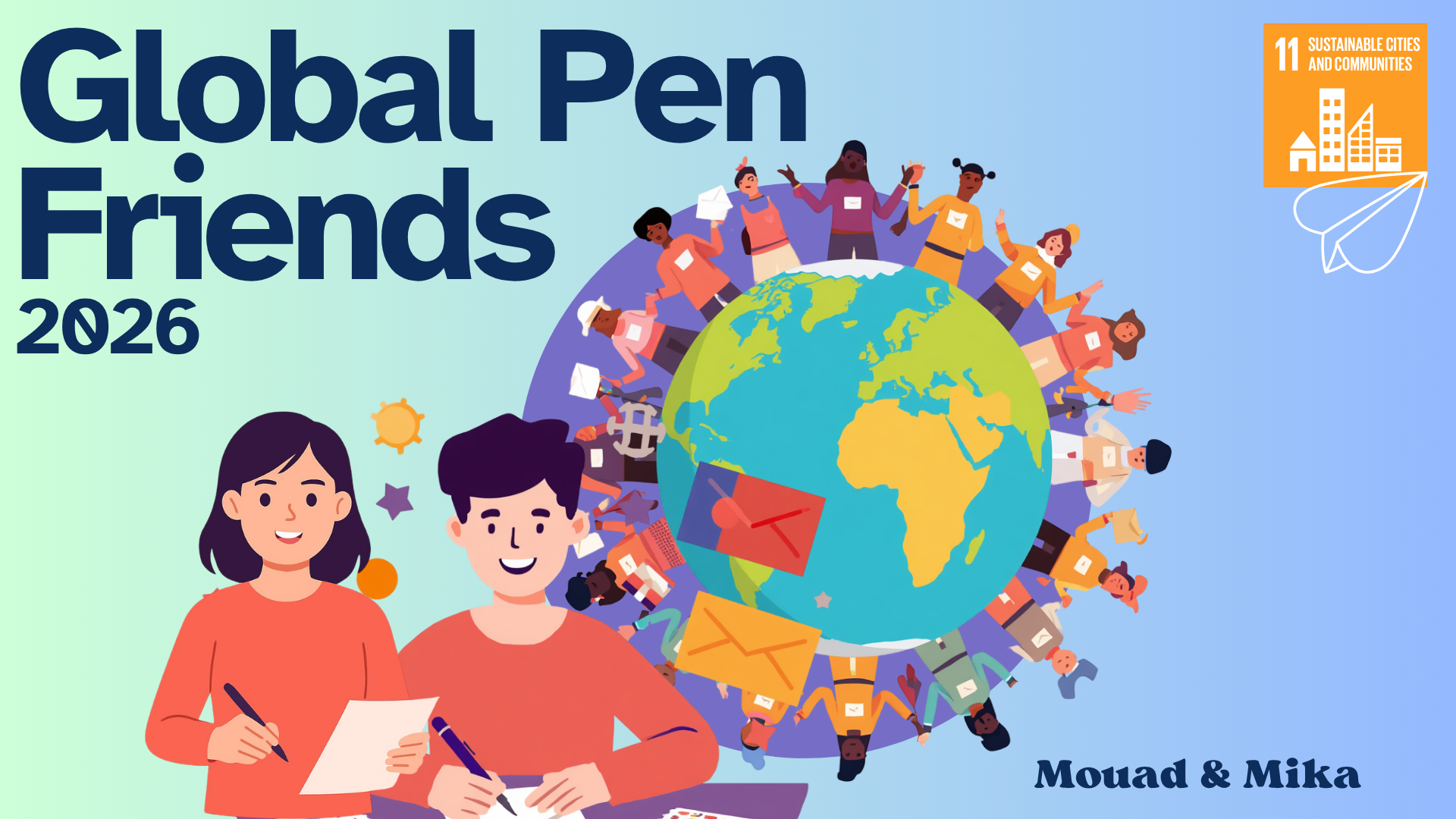
This letter exchange between Mika and Mouad explores the concept of inclusive cities through personal experiences in Belgium and Morocco. It reflects on diversity, urban inequality, and social cohesion, highlighting the role of public spaces, solidarity, and participatory approaches. Their dialogue emphasizes that true urban inclusion requires both structural planning and everyday human interaction to bridge social divides.
LETTER 1
MIKA KROUWEL
Dear Mouad,
I hope this letter finds you well. I’m excited to begin our exchange, which will focus on SDG 11: Inclusive, safe, resilient and sustainable cities. First of all, let me briefly introduce myself. My name is Mika, and I’m a 26-year-old doctoral student at the University of Antwerp in Belgium. I am originally from the Netherlands, where I grew up in the city of Utrecht, in the centre of the country. I moved to Antwerp for my master’s in Urban Planning and have been living there for five years now. During that time, I’ve had the opportunity to observe differences between countries, cities, neighbourhoods, streets and people that are physically very close to each other.
This experience showed me that people have very different perspectives on what inclusive cities mean, depending on their own contexts. It also made me realise how important it is to listen to and learn from these perspectives. My interest in inclusive cities comes from the idea that the world is a patchwork of diverse experiences across different places, yet even in very different contexts, there are always underlying similarities.
It was with this idea that I decided to join the Global Pen Friends programme. I am very excited to exchange thoughts with you on what inclusive cities mean from our personal experiences and across different cultural backgrounds, and to also find out that we might have more in common than may seem at first.
Cities seem to be growing faster and becoming more diverse than ever before. In Antwerp, for example, you can enter a completely different world just by crossing the street. The first neighbourhood I lived in, Borgerhout, is located next to the central train station, where every street seemed to reflect different cultural backgrounds: Nepalese restaurants, Afghan clothing stores, Lebanese bakeries, Turkish pharmacies, Brazilian coffee shops, Chinese supermarkets, Belgian cafés… all within a few metres of each other. To me, it felt like a miniature version of the world within walking distance.
Living in between all these cultural ‘bubbles’ was exciting, and I often found myself walking through these streets late at night, observing how different cultures coexisted in such a small space. However, it also seemed that these communities mostly lived alongside each other rather than with each other, as a complex layering of differences in a very dense place. This kind of ‘superdiversity’ is often linked to challenges such as segregation, inequality and poverty; issues that can create distance between people instead of connection. I became even more aware of this when I moved to another neighbourhood, the Studentenbuurt, just 500 metres away from Borgerhout.
As I moved from Borgerhout to the Studentenbuurt, a neighbourhood near the university, I entered a completely different ‘bubble’. Although it was in a very close distance, with only one major road dividing the two neighbourhoods, it felt so far removed from what I knew about Antwerp up to that point. The diversity I had experienced was replaced mostly by Belgian students and the occasional handful of tourists. But both in Borgerhout and in the Studentenbuurt, as well as in Antwerp as a whole, people have surrounded themselves with the familiar things they know, with familiar looking people around them and familiar thoughts and ideas about society.
Of course, this familiarity is logical; it makes sense to surround yourself with things that you recognise and that make you feel comfortable. But it also creates big divides between the different bubbles, making it almost impossible to break through this wall of familiarity. People living a kilometre away have completely different experiences of ‘their’ Antwerp. So a diverse city is definitely not automatically an inclusive city. I think the ability to have shared experiences between all these bubbles would make a city a real melting pot, otherwise it’s just a collection of bubbles that barely interact. I think this is the true challenge for inclusive cities. To be scared of the unfamiliar can be a big cause for all connected problems of segregation and inequality.
However, inclusivity is about so much more than only ‘sharing’ the city; it’s about whether different people can equally access, use and shape the city, about feeling comfortable, feeling safe to walk on the streets at night, and so much more that I didn’t write about yet. That is why I am very curious to hear your perspective. How are cities in Morocco shaped by diversity and inclusivity? What does an inclusive city mean to you? And how do you think cities can move from diversity to real inclusion and shared experiences?
I look forward to hearing from you and reading your letter.
Kind regards,
Mika
LETTER 2
MOUAD EL MANSARI
Dear Mika,
I hope this letter finds you well! I must admit that you probably thought I had forgotten you but here I am at last! I was truly happy to receive your letter, and as you likely already know from our WhatsApp conversations, my name is Mouad, 21 years old. I’m a Master’s student in Management of Social and Solidarity Economy Organizations and Social Innovation, and I am also a member of the student board of a club at my faculty, which keeps me deeply connected to the associative and community life of my university. I genuinely feel honoured to be exchanging letters with a doctoral student like you. It is a wonderful opportunity
to broaden my perspective and share our experiences across such different contexts. Before answering your questions, let me address something I had mentioned in a WhatsApp message that you may not have seen. You were wondering about exchanges between my city, Oujda and Algeria, given our proximity to the border. The reality is more complex than it might appear on a map. The borders between Morocco and Algeria have been closed for many years, and the situation worsened further after Algeria severed all diplomatic relations with Morocco in 2021, following a series of mutual accusations. Despite their geographical
closeness, the two countries are therefore currently deeply divided on a political level, which obviously affects the lives of people living in border cities like Oujda. That said, this letter is not meant to be a history lesson, so we will have time to come back to this in future exchanges if you are curious!
You asked me how diversity manifests itself in Moroccan cities. In Oujda, and in Morocco in general, diversity does not really represent a major problem for us. On the contrary, for a long time there has been a deep sense of solidarity among Moroccans, regardless of their origin. It is true that within the kingdom there are small cultural differences between the various regions, as well as sometimes quite noticeable linguistic variations. But personally, I find that to be a beautiful thing; a richness of nuances that coexist harmoniously within a shared national identity.
You also asked me what an inclusive city means to me. I believe that an inclusive city is above all a city where everyone can move freely and feel at home, regardless of their gender, origin, or social background. In Oujda, the feeling of safety in public spaces is unfortunately not experienced in the same way by everyone. Women, for example, often feel less comfortable walking alone at night, which limits their full participation in the life of the city. True inclusion therefore also requires safety and a sense of belonging for everyone, in every space of the city.
Finally, you wondered by what means a city can transform its diversity into genuine social cohesion. I believe the answer lies largely in shared public spaces. When people come together in a market, a park, a café terrace, or even on a football pitch, something deeply changes in their relationships. These informal spaces of encounter are where inclusion is quietly built, not through grand urban policies, but through small and everyday human interactions. A good example of this is the Al Haouz earthquake in 2023: in the face of that tragedy, Moroccans showed remarkable solidarity and empathy, regardless of their regional origins or cultural differences. That collective momentum showed me that social cohesion already exists deeply within us, it is simply a matter of nurturing it in our cities, day by day.
Finally, I am very curious to learn more about your doctoral research. What solutions are you exploring in your
work on urban planning? And do you think it is possible to design inclusion into a city, or is it something that can
only come naturally from the people themselves?
I look forward to your reply and to continuing this enriching exchange.
Kind regards, Mouad
LETTER 3
MIKA KROUWEL
Dear Mouad,
Thank you so much for your very inspiring letter. The past few weeks have been quite busy, so I have not been able
to reply sooner, I hope you understand. However, I was truly delighted by reading your letter and I’m very happy to
be exchanging thoughts with someone who expresses their thoughts and insights so well. You should not feel
honoured to correspond with me; on the contrary, I feel honoured to be exchanging thoughts with someone who
reflects so deeply on social inclusion and solidarity.
Let me first say that I am very curious about the way daily life is affected by conflicts in a border region like the
eastern region of Morocco. I would love to use this opportunity to learn more about this situation from someone
who experiences it directly, because I honestly know very little about it. Since the border with Algeria is closed for
years already, and diplomatic relations are troubled, how does this affect the personal relations between
Moroccans and Algerians? Do you feel these relations still meaningfully exist in such a complex situation, and how
was this situation before the countries became so divided and the border was ultimately closed? I find this
especially interesting because, from an outside perspective, Morocco and Algeria seem to share so much
culturally and historically, so I realise there is probably a lot about the relationship between the two countries that
I do not understand yet.
Furthermore, it is very interesting to read about how there exists such a deep sense of solidarity among Moroccans,
regardless of their origin. What, do you think, really represents this solidarity across such a big kingdom like
Morocco, with such different regions, cities, climates and people groups? Being from the Netherlands – a kingdom
as well – I feel like the monarchy somehow represents a shared history, even though the king of the Netherlands is
not the most loved public figure. In moments of crisis, grief or celebration, this criticism seems to fade temporarily
and the monarchy seems to be able to connect people in a certain way. For instance, the king and queen are
central to a yearly memorial service for those who died in the Second World War and in other situations after that,
which is a very moving and connecting experience for many Dutch people. I’m curious how such shared moments
are experienced in Morocco, at least from your own perspective.
Talking about the lack of feeling safe in a city like Oujda is something that I recognise. I must say, as a young man,
I realise that I am in a privileged position where I generally do not have to feel as unsafe in urban areas as many
others do. However, this also causes a big responsibility in making others feel safe in their own city. Whether
through big changes by implementing gender-friendly design in urban planning (since many cities are still shaped
around the ways men use and experience public space), or through small, day to day gestures on the street. This
directly connects to the way you referred to public spaces as the answer to creating genuine social inclusion. The
way people look after each other could have such an impact on feelings of inclusion, which is why the Al Haouz
earthquake you talked about is something very important to reflect on.
Of course, solidarity does not come only from shared tragedy. Since you mentioned that you wrote your bachelor
thesis on the collaborative economy, this made me wonder whether you see a connection between these kinds of
solidarities and the way people organise small scale economic life in Morocco. Maybe you can tell me a bit more
about the research you did? And do you feel that mutual aid and community networks still play an important role
in everyday life in the situation you studied?
I would also like to thank you for being interested in my doctoral research. I will briefly explain what I’m doing with
this research first: in short, I focus on the struggle for housing in the Brazilian city of Recife, where there is both a
deep housing crisis leaving many homeless and displaced, and at the same time a lot of abandoned buildings in
the historical city centre. Because the centre was planned mainly around commerce and offices, many residential
functions disappeared, while poorer communities were pushed further away from the city. In this contrasting
situation, some marginalised groups have started to occupy empty buildings in the centre as a way of claiming
their right to housing and urban space. Although these occupations are officially illegal, they are often the only
groups actively living in and caring for the city centre.
My research explores how these communities can participate in urban redevelopment without simply being
displaced or evicted. I work through participatory research, meaning that the residents themselves help shape the
whole research process and the conclusions that are formulated. Ultimately, I hope this can contribute to more
inclusive approaches to urban redevelopment, not only in Brazil but perhaps elsewhere too, especially as housing
crises are also growing in countries like Belgium and the Netherlands. I’m very curious whether similar issues exist
in Morocco. Would you say cities like Oujda experience housing pressure as well? And how do larger cities such
as Casablanca, Tanger, Marrakesh or Fez deal with housing and historical city centres?
To conclude, I wanted to ask you about your own studies. In our whatsapp conversation, you mentioned you plan
to start working on your master’s thesis this summer. Are there particular social issues or questions you are
especially interested in researching? And would you like to focus on a topic in your hometown Oujda, elsewhere
in Morocco or more internationally? It would be great to exchange thoughts about your thesis once you begin
working on it, so be sure to share ideas if you want!
I’m already looking forward to hearing back from you! Be sure to write back whenever you have the time; I really
enjoy reading your thoughts and reflections. I hope we can stay in touch!
Kind regards,
Mika
LETTER 4
MOUAD EL MANSARI
Dear Mika,
Here I am again! I hope this letter finds you well. Thank you for your thoughtful and generous letter, it expresses a lot of warmth and genuine curiosity and I truly enjoyed reading it. I have also been very busy with my studies lately so I completely understand the delay on your end.
In this letter, I will respond to most of your questions and I will save the one about Moroccan-Algerian social ties for the end, as it deserves a more careful treatment.
Before anything else, I want to thank you for taking the time to explain your doctoral research. The situation you describe in Recife where marginalised communities occupy abandoned buildings in a city centre shaped around commerce rather than people, is both striking and deeply relevant. What I find most valuable in your approach is the participatory dimension: giving residents a real role in shaping the research itself, not just being its subject. That is a form of intellectual honesty that I genuinely admire !
You drew an interesting parallel between the Moroccan and Dutch monarchies and how both seem to connect people in moments of crisis or celebration and I think this comparison holds, though with some nuances. In Morocco, the monarchy does play a unifying role ; not only symbolically, but also in practice ; royal interventions during major crises, such as the Al Haouz earthquake in 2023, tend to mobilise both institutions and ordinary citizens very rapidly. But what I find more meaningful is grassroots solidarity: neighbourhood mutual aid, informal support networks and the concept of “twiza” whitch is a traditional form of collective community work, especially in rural areas which exists independently of any political figure. What connects Moroccans across very different regions : the Sahara, the Rif, the Atlantic coast, the east, is probably a shared sense of belonging to something ancient and resilient, even when daily life looks completely different from one city to another.
Since you mentioned that you found my bachelor thesis topic interesting, let me tell you a bit more about it. My thesis explored the impact of the collaborative economy on employment with an international perspective rather than a focus on Morocco alone. What I found is that the collaborative economy produces deeply ambivalent effects on labour markets: it creates new forms of flexible income and economic participation, but it also raises serious questions about job security, social protection, and the blurring of the line between worker and entrepreneur. These tensions are not specific to any one country, they appear across very different economic contexts, which is precisely what made the international approach necessary.
Regarding my master’s thesis, the direction is still taking shape, but the central question I want to explore is whether the Social and Solidarity Economy can simultaneously act as an economic booster for Morocco and as a concrete response to youth unemployment. The ESS model : cooperatives, associations, social enterprises , carries real potential for creating inclusive and territorially rooted employment. But whether it can operate at a scale significant enough to address structural youth unemployment is a question that deserves serious empirical investigation. I would be very curious to hear your thoughts on this, especially given your experience with participatory and community-based research.
You also asked whether cities like Oujda experience housing pressure, and how larger Moroccan cities deal with their historical centres. Oujda does experience housing pressure, though differently from Casablanca or Tanger. Here, the issue is more about quality and informality than extreme density: many neighbourhoods grew without proper urban planning and access to decent housing for young families is increasingly difficult. In larger cities, the situation is more acute; rising rents, displacement of lower-income communities from central areas and a growing disconnect between formal planning and lived urban reality. Historical medinas in cities like Fez or Marrakech face a dual pressure: gentrification driven by tourism on one side, and neglect of non-touristic areas on the other. Your research in Recife resonates strongly with these dynamics; the right to urban space is just as contested here, even if the legal and political contexts differ.
Finally, as promised, I come to the question of Moroccan-Algerian social ties. It is true that before the border closure, Oujda was a very lively city shaped largely by the constant flow of exchanges, trade and human connections with the Algerian side. That openness was part of the city’s identity. The closure changed that deeply, and there are indeed real cases where families found themselves divided between the two countries, maintaining their bonds across a border that politics made almost impenetrable. That said, and especially with the advancement of technology, these distances tend to shrink. Social media, messaging apps, and digital communication have allowed people to stay connected in ways that were simply not possible before, and I think that matters more than it might seem.
I would like to close this letter with something that goes beyond the deadline of the Global Pen Friends programme. This exchange does not have to end here. You are welcome to reach out whenever a question or a thought crosses your mind and I will do the same. These letters have genuinely opened me up to a different culture, a different way of thinking, and some truly interesting ideas that I would not have encountered otherwise. For that, I am sincerely grateful and I hope we can continue in whatever form that takes.
Kind regards,
Mouad