
Under this research line, we examine situations and processes of state underreach (fragile or failed states), state reach (developmental states) or state overreach (such as in state crime or structural violence). We aim to understand how state attributes such as government, territory, law, nation or power are articulated or not, and how state actions such as legitimation, economic accumulation or security and services take shape. A focus on the changing patterns of tightening and loosening state reach across space and time implies attention to societal resilience. This is the ability of societies to resist, adapt to or recover from (the consequences of) a lack of state presence and/or performance, sudden man-made or natural shocks or long term social exclusion and adverse incorporation. In this blog, we mention a few of the 2025 activities that relate to this research line.
Outreach with the Egmont Institute
In 2025, Kristof Titeca engaged with policy debates through a series of publications with the Egmont Institute. In Beyond the Jihadist Label, co-authored with Giovanni Salvaggio, he examines violence attributed to the Allied Democratic Forces (ADF) in eastern DRC. Drawing on long-term fieldwork in eastern Congo and Uganda, the report argues that ADF violence cannot be reduced to jihadism alone. Instead, it highlights a multilayered configuration in which ideological, military, political and economic dynamics intersect. The analysis shows how patterns of violence are embedded in taxation, trade, resource extraction and local power struggles, and how the “ADF label” circulates within broader economies of conflict.
Together with Yotam Gidron, Kristof also published a policy briefing on Uganda’s refugee policy. The briefing critically revisits the so-called “Ugandan model” of refugee protection, questioning assumptions about self-reliance and socio-economic integration. In a context of rising refugee numbers and declining international support, the analysis points to mounting tensions and the erosion of the delicate equilibrium between donor funding, state interests and societal tolerance that has sustained the open-door policy.
In addition, on the Egmont blog, Kristof published his analysis on the escalating conflict in Sudan, unpacking the dynamics that make the crisis increasingly complex and harder to contain.
Launch of EDUGODDS – Education against all odds
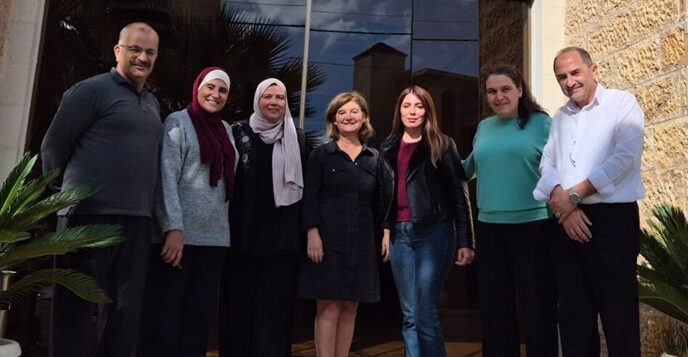
In November 2025, a partner week in Jordan marked the start of the EDUGODDS project (Education against all odds), a new VLIR partnership focused on strengthening higher education in Palestine through evaluation capacity and institutional learning. Jointly led by Al-Quds Open University (QOU), the Palestinian Evaluation Association and IOB, the project brings together academic and practical evaluation expertise to support resilient and evidence-informed higher education systems in challenging contexts. The partner week provided a productive start to the collaboration, laying the foundations for a strong and committed EDUGODDS team.
EMPURECO – Partnership with MUST
In October, Kristof Titeca joined colleagues at Mbarara University of Science & Technology (MUST) in Uganda for research masterclasses and stakeholder meetings under the EMPURECO project (Empowering Ugandan Refugee-Host Communities in Becoming Climate Resilient). This VLIR-UOS partnership (2024–2029) between the University of Antwerp and MUST aims to strengthen research capacity and advance climate resilience in Uganda’s refugee-hosting communities. Sessions focused on research design, epistemology and mixed methods, linking methodological rigour to community-based challenges. The collaboration brings together Ugandan and Belgian partners in a shared commitment to research excellence, capacity building and societal impact.
Electrification beyond infrastructure
More than 560 million people in Sub-Saharan Africa still live without electricity – many of them in fragile and conflict-affected regions, where infrastructure investments are especially risky. In a publication in Energy Economics, called “From demand deficit to development strategy: navigating mini-grid viability in a fragile context”, IOB researchers Elie Lunanga, Nik Stoop and Marijke Verpoorten, together with Sébastien Debureaux, examine the viability of renewable mini-grids in fragile settings. Drawing on detailed field data in eastern DRC, the study shows that electrification is not merely a technical fix but a coordination challenge: escaping low-demand traps requires cross-sectoral action and strong public–private partnerships. Energy access becomes transformative only when embedded in a broader development strategy.